
Shopify Development Agencies: 7 Top Picks for 2026
Compare 7 leading Shopify development agencies for 2026 — specialties, pricing models, and a practical checklist for choosing the right partner.
Your brand has outgrown its ecommerce setup. Merchandisers need developer help for routine changes, integrations need constant attention, and the next international launch looks harder than it should. You search for Shopify development agencies and find near-identical pitch decks promising end-to-end ecommerce solutions.
The differences become clearer when you look past the homepage. Specialization determines whether an agency can handle your migration, custom theme, Shopify Plus architecture, or operational integrations. Pricing structure determines how you'll manage uncertainty. Evidence determines whether you're buying demonstrated capability or a convincing presentation.
- Match the work: A polished storefront doesn't prove an agency can reconcile historical orders or rebuild B2B pricing.
- Compare commercial terms: Fixed-scope projects, retainers, and time-and-materials engagements allocate risk differently.
- Inspect delivery: Live stores, relevant code, and case studies with verifiable outcomes matter more than broad capability claims.
The agencies below suit different briefs, from enterprise replatforming to theme craftsmanship and broader digital transformation. Each gets a best-fit assessment, practical strengths, and limitations rather than a popularity ranking. United Victory Technologies publishes this comparison and is included, so apply the same evidence standards to us as you would to any other shortlisted agency.
Table of Contents
- 1. United Victory Technologies
- 2. Anatta
- 3. SDG
- 4. 1Digital Agency
- 5. Magebit
- 6. Bounteous
- 7. LIM
- Top 7 Shopify Development Agencies Compared
- Your Shopify Agency Evaluation Checklist
<a id="1-united-victory-technologies"></a>
1. United Victory Technologies
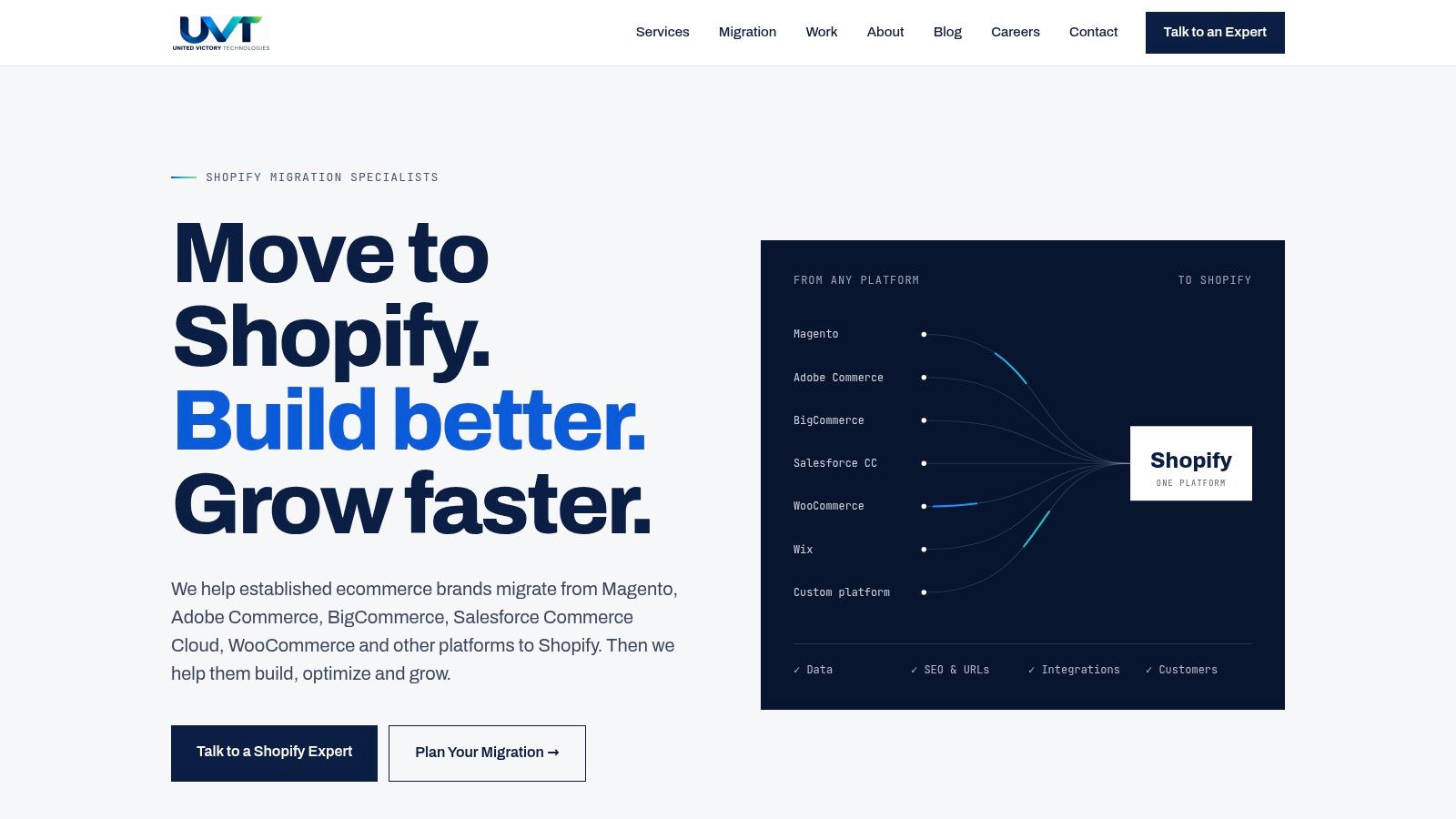
A replatforming project fails in the unglamorous places: historical orders that don't reconcile, redirects nobody mapped, a theme the merchandising team can't edit without filing a ticket. United Victory Technologies suits established brands pairing a migration with custom Shopify development and ongoing work after launch.
Our scope covers migrations from Magento, Adobe Commerce, BigCommerce, Salesforce Commerce Cloud, WooCommerce, Wix, Squarespace, and custom platforms, alongside new builds on Online Store 2.0, Shopify Plus architecture, custom themes, integrations, and international commerce. Custom-platform moves follow the same logic: retire the bespoke code, keep the functionality that matters.
The theme work is where this shows most clearly. Developers work directly with designers during the build, flagging early when a design won't translate cleanly into a section-based theme. Themes ship Liquid-first with reusable blocks and merchant-editable settings, and the team maintains a component library across projects, so each new build starts from tested sections rather than a blank repo. Performance is treated as a design constraint from the first line of code.
<a id="where-the-approach-fits"></a>
Where the approach fits
- Migration continuity: Data models from Magento, WooCommerce, BigCommerce, and other platforms get mapped onto Shopify's structure, including historical orders, content, and redirects.
- Custom functionality: Configurators, bundles, and custom checkout logic on Shopify Plus, plus backend work like pricing engines and approval workflows for custom apps.
- Theme craftsmanship: Section-based architecture with clean, maintainable Liquid that another developer can safely touch six months later.
Practical rule: A migration isn't complete because the new homepage is live. Merchants still need accurate orders, functioning integrations, and a storefront their team can maintain.
A reasonable standard for judging any agency is the evidence it demands from its own developers. We ask Shopify applicants for a link to code they've shipped, a live store, or a GitHub repo, and theme applicants for a live store they themed, because shipped work tells more than a resume. Apply the same test to us and to every agency on this list.
The trade-offs: The service range is broad, so the quality of the scoped proposal matters more than the capability list. Enterprise clients can request a conversation with a Shopify Expert before committing, which is worth doing to test how the team reasons about your specific systems. For a procurement framework, our guide to choosing a Shopify development company separates technical fit from sales presentation. The strongest fit is a brand that needs continuity across migration, development, and post-launch improvement, rather than a standalone visual refresh.
<a id="2-anatta"></a>
2. Anatta

A migration becomes an enterprise program when ecommerce, operations, finance, and regional teams all depend on the same launch. Anatta is a strong candidate for large, multichannel brands with that level of coordination.
Its supplied service profile covers enterprise replatforming, operational integrations, international commerce, and ongoing optimization. That makes it relevant when the difficult work sits behind the storefront, particularly around catalogs, customer records, and multi-brand operations.
Best for enterprise merchants whose Shopify project requires organizational and systems coordination. A suitable brief might involve replacing a legacy commerce platform while preserving warehouse workflows and keeping merchandising teams productive. A design-only proposal wouldn't address that requirement.
<a id="what-to-examine-in-the-proposal"></a>
What to examine in the proposal
The useful distinction is between an agency that can connect a system and one that can explain how the connection behaves when something fails. ERP, OMS, and WMS work should include ownership of inventory updates, order status, exception handling, and reconciliation.
- Strength: An enterprise-oriented scope connects storefront implementation with operational systems.
- Limitation: That breadth may be unnecessary for a smaller merchant with a straightforward catalog and few dependencies.
- Commercial consideration: Pricing requires a scoped proposal rather than comparison against a published project fee.
A broader explanation of what a Shopify agency does can help define which responsibilities belong in the statement of work. Keep strategic planning, implementation, and ongoing optimization distinct so you can see what you're buying.
Verdict: Shortlist Anatta when coordination is a major delivery risk. For a narrow theme rebuild, assess whether its enterprise approach adds useful oversight or more process than your team needs.
<a id="3-sdg"></a>
3. SDG

SDG fits a migration brief where catalog structure, connected systems, and launch stabilization need as much attention as design. Its supplied profile emphasizes Shopify Plus builds, enterprise migrations, redirects, integrations, testing, and post-launch monitoring.
For a merchant moving from Magento or another legacy platform, those disciplines should appear as explicit deliverables. “Data migration” is too broad if the proposal doesn't distinguish product relationships, customer records, content, and operational dependencies.
SDG's enterprise orientation makes it relevant to brands with complicated catalogs and ERP, OMS, or PIM connections. The practical question is whether the proposed team can show how it validates the destination data against the source, rather than just demonstrate that an import completed.
Don't make visual approval the final launch gate. Make data validation, redirect testing, and successful order processing separate sign-offs.
<a id="assess-the-architecture-not-just-the-badge"></a>
Assess the architecture, not just the badge
Partner credentials help establish context, but they don't resolve project fit. The guide to Shopify partner tiers is useful background; the stronger procurement evidence is a delivery plan that addresses your dependencies.
- Best fit: Enterprise replatforming with complex catalogs and back-office connections.
- Strength: Migration planning extends beyond rebuilding page templates.
- Limitation: Smaller merchants may not need an enterprise delivery model.
- Pricing: Public pricing isn't provided in the supplied agency information.
A credible launch plan should also explain who investigates discrepancies after cutover. If stock quantities differ or order acknowledgments fail, the merchant shouldn't have to coordinate competing vendors without an accountable technical lead.
Verdict: Consider SDG when migration governance is central to the brief. Compare its validation and stabilization scope carefully against other enterprise proposals rather than choosing on storefront presentation alone.
<a id="4-1digital-agency"></a>
4. 1Digital Agency
A storefront rebuild can expose a procurement gap: developers own the build, an SEO consultant owns recommendations, and nobody owns implementation across both. 1Digital Agency merits consideration when development and search continuity need coordinated delivery.
Its supplied service scope combines Shopify and Shopify Plus migration, development, SEO, and ongoing support. It also includes section-based theme development and Hydrogen work, giving merchants different implementation options rather than a single build approach.
Best for brands seeking development and SEO within a broader ecommerce engagement. The advantage is potential coordination. The corresponding risk is assuming that a broad service menu guarantees the right specialists will be assigned to your project.
<a id="keep-the-build-decision-explicit"></a>
Keep the build decision explicit
A custom theme and a headless storefront shouldn't be interchangeable proposal options. Require a clear explanation of what the business gains, what the internal team must maintain, and which additional responsibilities each approach introduces.
- Theme-led brief: Prioritize editable sections, merchandising flexibility, accessible interactions, and maintainable code.
- Migration brief: Specify URL mapping, content transfer, integration testing, and launch monitoring.
- Headless brief: Establish a business requirement that justifies the additional implementation and support responsibilities.
Performance belongs in that discussion. Shopify reports that each additional 100 milliseconds of loading delay can reduce conversions by approximately 3.5%, a directional benchmark rather than a forecast for your store (Shopify's speed and conversion analysis).
The trade-offs: Migration fees depend on scope, and a published starting rate for a selected development service wouldn't establish the price of your complete project. Confirm the named delivery roles and distinguish development, SEO implementation, and recurring support in the proposal.
Verdict: A useful shortlist option when the brief combines storefront execution with search considerations, provided ownership stays explicit.
<a id="5-magebit"></a>
5. Magebit
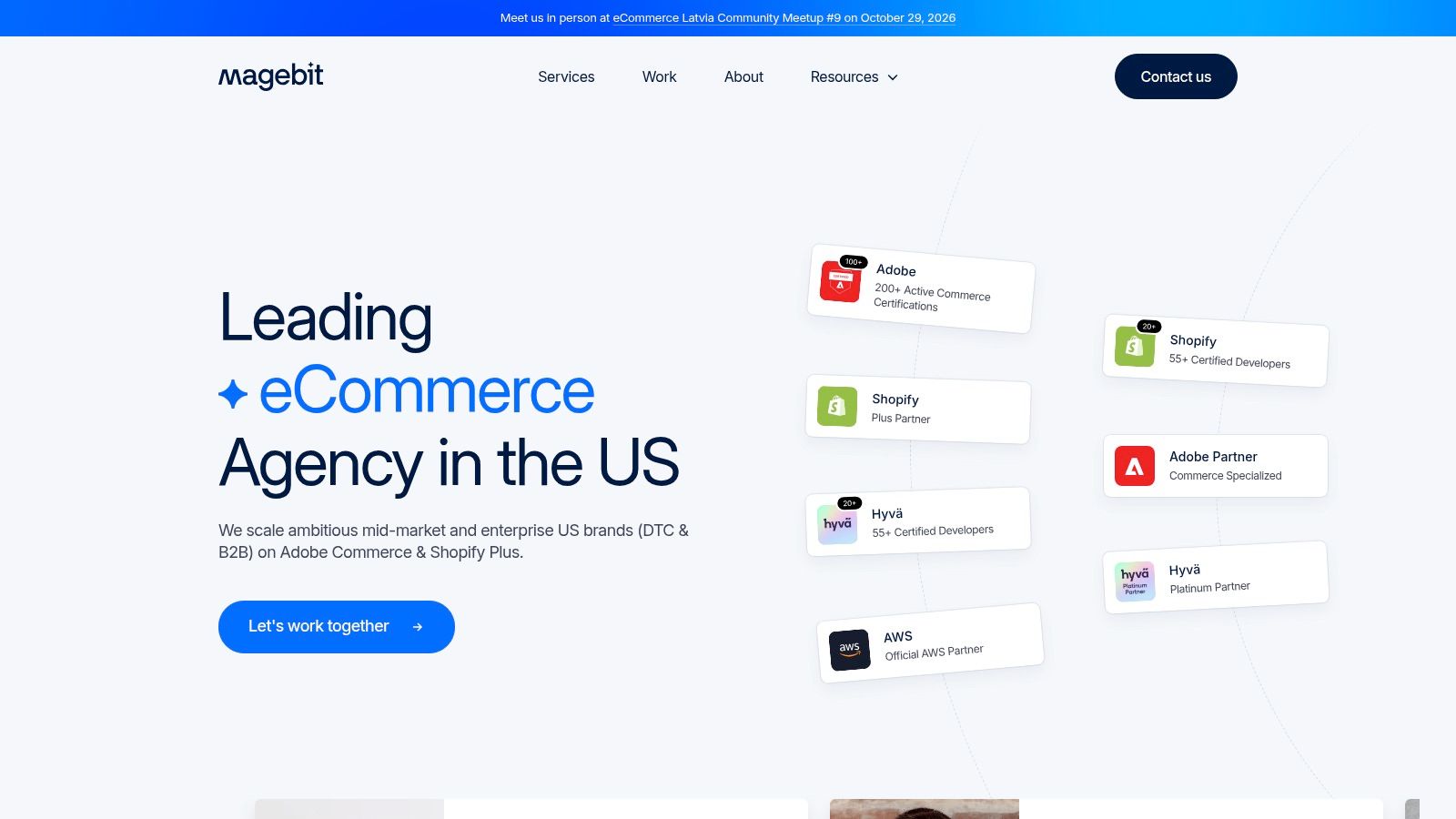
Leaving Magento or Adobe Commerce requires more than knowledge of the destination platform. Someone must understand which legacy behaviors the business needs and which ones it can retire.
Magebit is worth considering for that cross-platform perspective. Its supplied profile covers Adobe Commerce and Shopify Plus, with migration, custom development, integrations, conversion optimization, and maintenance. That combination is relevant to mid-market and enterprise merchants whose requirements include B2B or connected operational systems.
Best for Adobe Commerce merchants that need a deliberate translation of legacy functionality into Shopify. Rebuilding every existing customization can preserve unnecessary complexity. Removing everything custom can break valuable business processes.
<a id="make-legacy-decisions-visible"></a>
Make legacy decisions visible
A practical discovery exercise should assign each requirement to a destination approach.
- Retain: Preserve workflows that support essential commercial or operational needs.
- Replace: Use an appropriate Shopify capability or integration where it meets the requirement.
- Retire: Remove functionality that no longer has an accountable business owner or clear purpose.
Magebit's supplied capabilities include ERP, CRM, PIM, and fulfillment integrations, alongside B2B, Hydrogen, and omnichannel work. The value of that breadth depends on whether the architecture remains understandable to the merchant's internal team.
Architecture check: An agency should be able to explain why a requirement needs custom code and who will maintain it. Technical possibility alone isn't a business case.
The trade-offs: Its headquarters are outside the US, although the supplied information identifies a US presence and US clients. Establish working-hour overlap, escalation coverage, and who can approve production changes. Pricing isn't publicly listed in the supplied material.
Verdict: A relevant candidate when knowledge of both the old and new platforms matters. Keep the engagement focused on simplifying the operating model, not recreating the legacy system under a different platform name.
<a id="6-bounteous"></a>
6. Bounteous
Choose a broader consultancy when the business problem extends beyond the store. Bounteous belongs in that conversation for merchants connecting Shopify implementation with a wider digital commerce program.
Its supplied profile emphasizes complex Shopify Plus implementations, omnichannel commerce, and broader consulting capabilities. That makes it a different proposition from a narrowly focused theme studio or migration specialist.
Best for enterprises coordinating commerce with wider organizational change. A project involving regional teams, customer experience, analytics, and operational processes may benefit from broader program oversight. A self-contained storefront refresh may not.
<a id="separate-implementation-from-transformation"></a>
Separate implementation from transformation
A wide scope needs clear boundaries. Otherwise, merchants can struggle to distinguish decisions required for launch from longer-term strategic work.
- Launch requirements: Identify the commerce capabilities and dependencies required to transact reliably.
- Program responsibilities: Name who owns analytics, localization, experimentation, and operational changes.
- Later improvements: Keep nonessential initiatives outside the critical launch path unless the business case supports them.
The enterprise operating model deserves particular attention. A Shopify proposal should make recurring app costs, integration ownership, localization responsibilities, and support capacity visible, even when the initial project focuses on implementation.
Bounteous's broader remit may help connect those decisions, but it also creates a procurement responsibility: confirm which specialists will deliver the Shopify work and how decisions reach them. A large capability map isn't the same thing as a named delivery team.
The trade-offs: The supplied information is less migration-specific than that of some agencies in this comparison. Public pricing isn't listed, and a broader consulting engagement may add unnecessary overhead to a tightly scoped build.
Verdict: Shortlist Bounteous when Shopify is part of a larger commerce transformation. For migration-only procurement, compare the detailed cutover and validation plan against specialist proposals.
<a id="7-lim"></a>
7. LIM

LIM offers a Shopify-focused alternative for merchants that don't need a broad digital consultancy. Its supplied profile covers store builds, migrations, integrations, custom apps, headless commerce, wholesale/B2B, and ongoing optimization.
That makes it relevant to a US merchant seeking a focused agency relationship across implementation and improvement. The important distinction is between having a service category available and demonstrating experience with the precise workflow your business needs.
Best for Shopify-focused builds that combine storefront work with selected custom functionality. A hybrid B2B/B2C merchant, for example, should evaluate product visibility, account permissions, pricing behavior, and order handling together rather than approve isolated feature demonstrations.
<a id="test-the-everyday-workflow"></a>
Test the everyday workflow
A useful walkthrough follows the people who will operate the finished store. Have the agency explain how a merchandiser updates a landing page, how a wholesale buyer places an order, and how operations investigates a failed synchronization.
- Build quality: Inspect editor usability and maintainability, not only the customer-facing design.
- Integration quality: Establish monitoring, error handling, and ownership of failed updates.
- Optimization quality: Require an agreed measurement approach before accepting claims about improvement.
For performance acceptance, Shopify's reports use 30 days of real-user data, which makes post-launch validation important alongside pre-launch testing (Shopify Web Performance reporting). Define who reviews those reports and who acts when a release introduces a regression.
The trade-offs: The supplied public migration details and project metrics are more limited than those described for some enterprise-oriented agencies. Pricing isn't published, and complex catalog or integration projects need especially relevant evidence before contracting.
Verdict: Consider LIM for a focused Shopify engagement, with extra technical diligence when business-critical systems or complicated wholesale workflows are involved.
<a id="top-7-shopify-development-agencies-compared"></a>
Top 7 Shopify Development Agencies Compared
A logo wall tells you nothing about fit for a replatform versus a ground-up theme build. These seven cluster into distinct specializations: enterprise replatforming, Shopify Plus architecture, theme craftsmanship, and broad digital consultancy. Where published metrics are thin, the burden shifts to your diligence calls rather than disqualifying the agency outright.
| Agency | 🔄 Implementation Scope & Complexity | ⚡ Scale / Resource Fit | 📊 Published Outcomes or Evidence | ⭐ Key Advantages | 💡 Ideal Use Cases |
|---|---|---|---|---|---|
| United Victory Technologies | Platform migrations, Online Store 2.0 and Shopify Plus builds, custom themes and apps, integrations, and CRO | Established brands needing migration and ongoing development; pricing by quote | Anonymized case studies under NDA; no public numerical outcomes published | Multi-platform migration experience, continuing development, expert access for enterprise clients | Brands migrating from Magento, WooCommerce, BigCommerce, or custom platforms that want development support after launch |
| Anatta | Complex replatforming, operational-system integrations, international and multi-brand commerce | Enterprise brands with substantial catalogs and data | Published migration examples include buybuy BABY and Dorel Juvenile | Enterprise experience and ERP, OMS, and WMS integration capabilities | Large, multi-channel or multi-brand businesses |
| SDG | Enterprise migrations with data, redirects, integrations, testing, and launch stabilization | Large catalogs, including millions of SKUs; enterprise-oriented | Published Jenni Kayne Magento-to-Shopify Plus case study | Covers migration planning and post-launch monitoring | Brands with very large catalogs or complex back-office systems |
| 1Digital Agency | Migration, SEO, redirects, theme rebuilds, integrations, and launch support | Broad service range; migration pricing quoted after scoping | Offers migration-specific services; some Shopify Plus development rates are published | Combines development, SEO, Hydrogen, and ongoing maintenance | Merchants seeking migration plus SEO or continuing support |
| Magebit | Cross-platform migrations, custom development, integrations, B2B, and omnichannel work | Mid-market and enterprise; pricing by quote | Public case studies include Shopify work and multi-region commerce | Adobe Commerce and Shopify experience; supports complex integrations | Magento or Adobe Commerce merchants with B2B or integration needs |
| Bounteous | Complex Shopify Plus implementations and omnichannel commerce; migration focus is less prominent | Enterprise programs; may be heavyweight for a narrow project | Public examples include Staples Canada, Chatters, and Gaia Herbs | Shopify capabilities within a broader digital consultancy | Businesses integrating Shopify into a wider transformation program |
| LIM | Shopify builds, migrations, integrations, custom apps, and headless commerce | Shopify-focused option; request references for large or complex projects | Public migration metrics and details are limited | Shopify-focused services with B2B and post-launch optimization | US merchants seeking a Shopify-focused partner for builds or migrations |
<a id="your-shopify-agency-evaluation-checklist"></a>
Your Shopify Agency Evaluation Checklist
The right shortlist starts with your project's main risk. For some brands, that's preserving organic visibility during migration. For others, it's making a custom theme manageable, connecting an ERP, or supporting regional operations without accumulating unnecessary custom code.
Compare agencies against the same written brief. Otherwise, the cheapest proposal may exclude work that another agency has included.
- Specialization match: Request a pair of case studies matching your project type, whether that's migration, theme development, Shopify Plus architecture, or integrations. Relevant complexity matters more than recognizable logos.
- Proof over promises: Inspect a live store, shipped code sample, or shareable repository. At UVT, our developer recruitment process requests shipped code, a live Shopify store, or a GitHub repository; our theme recruitment also prioritizes a live built theme over a résumé alone.
- Post-launch ownership: Establish whether the delivery team stays involved or hands responsibility to a separate support function. Record escalation ownership, documentation requirements, and responsibility for integration failures.
- Migration safeguards: Require redirect maps, data validation, a rehearsed cutover, launch monitoring, and decision gates for unresolved issues. Assign owners to source-data approval and destination-data reconciliation.
<a id="choose-the-pricing-model-deliberately"></a>
Choose the pricing model deliberately
Fixed-scope pricing suits well-defined deliverables and acceptance criteria. It becomes harder to compare when assumptions remain unresolved, so document exclusions and the change-control process before signing.
Monthly retainers suit a continuing development and optimization backlog. Define how work is prioritized, what capacity is reserved, and whether urgent support displaces planned improvements.
Time and materials suits discovery or implementation with genuine uncertainty. Require transparent reporting, budget checkpoints, and approval rules so flexibility doesn't become an open-ended commitment.
The useful comparison isn't the headline fee. It's the cost of an agreed scope, the assumptions behind it, and the responsibilities that remain with your team.
Keep Shopify subscriptions, apps, payment costs, third-party services, and ongoing agency work separate from implementation fees. A platform change can simplify operations without making every architectural choice financially sensible.
Before committing, benchmark the proposed team, scope, and support model against your actual operating requirements. If you're weighing a migration or Shopify Plus build, a scoped assessment or conversation with a Shopify Expert can help expose gaps before they become contractual disagreements.
United Victory Technologies offers structured Shopify migrations, custom development, Shopify Plus architecture, integrations, and ongoing optimization for established ecommerce brands. Visit United Victory Technologies to request a scoped assessment or speak with a Shopify Expert about your migration risks, implementation requirements, and agency shortlist.