7 Shopify Plus Agencies Compared for Enterprise Stores
Compare 7 Shopify Plus agencies on enterprise capabilities, checkout extensibility, and multi-region support, with strengths, trade-offs, and who each suits.
Most shopify plus agencies look impressive in a deck. Enterprise teams usually learn the hard way that the risk sits elsewhere, in a checkout that can't handle B2B terms, a multi-region rollout that breaks pricing logic, or a migration that ships without clean redirects and reconciled data. If that's the stage you're at right now, this shortlist compares seven Shopify Plus partners on the questions that decide outcomes, checkout extensibility, multi-region setup, and how they handle migration and integration risk.
Table of Contents
- 1. United Victory Technologies
- 2. We Make Websites
- 3. Diff
- 4. Fuel Made
- 5. BlueSwitch
- 6. Verbal+Visual
- 7. Arctic Grey
- Shopify Plus Agencies, 7-Agency Comparison
- Turning This Shortlist Into a Confident Partner Decision
<a id="1-united-victory-technologies"></a>
1. United Victory Technologies
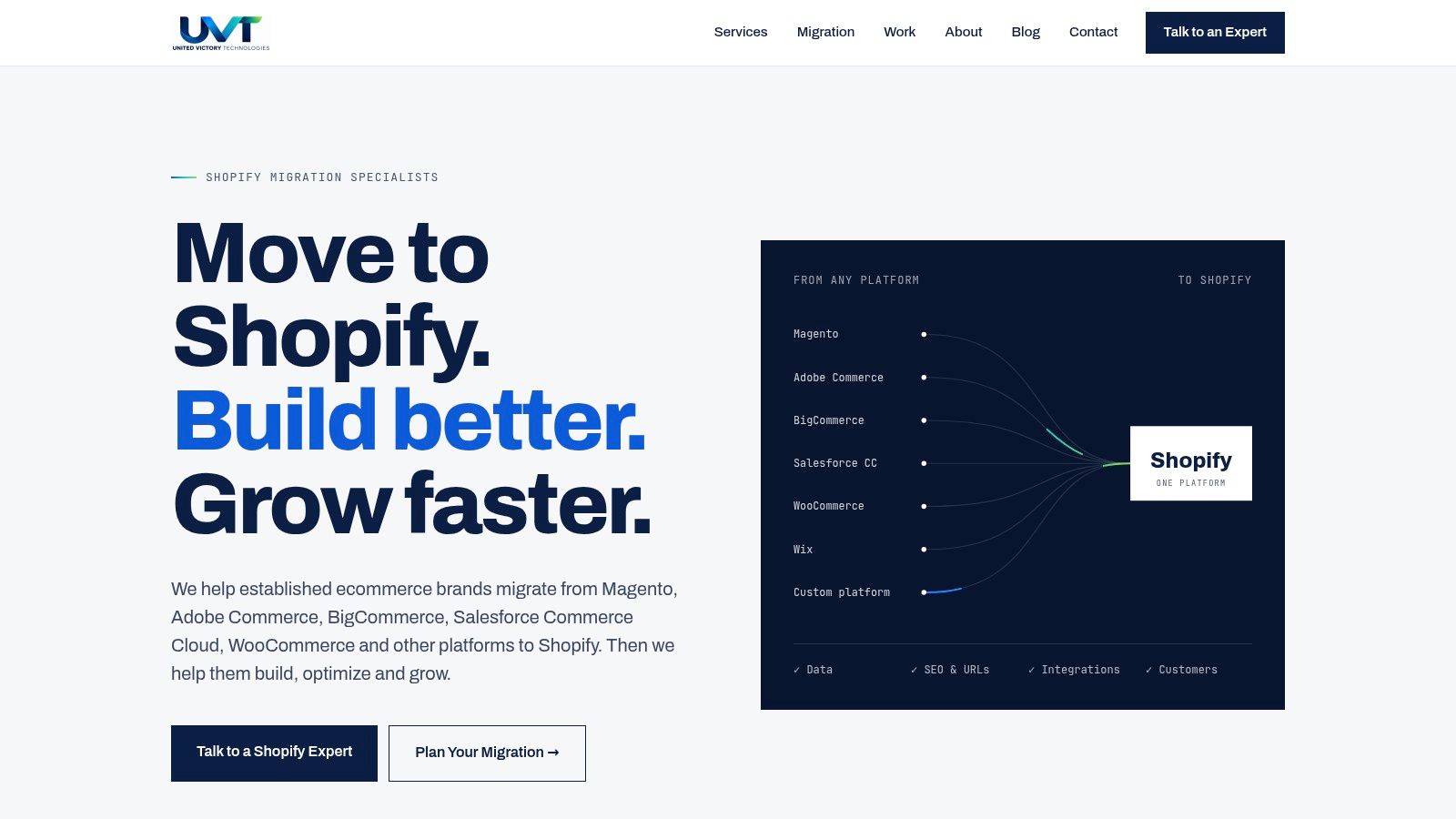
United Victory Technologies is the clearest fit when the project starts with risk, not visuals. Its migration posture matches what enterprise buyers worry about most, data integrity, SEO continuity, core integrations, and the practical mess of moving from Magento, Adobe Commerce, BigCommerce, Salesforce Commerce Cloud, WooCommerce, or custom stacks into Shopify or Shopify Plus.
<a id="where-it-stands-out"></a>
Where it stands out
The agency treats migration as a controlled rebuild, not a theme swap. That matters when products, variants, pricing, customer accounts, order history, content, media, and redirect maps need to move with enough discipline to protect search equity and support the business after launch. Its Shopify Plus work also goes beyond storefront polish, with checkout extensibility, Shopify Functions, B2B features, Shopify Markets, multi-currency, multi-language, and ERP, PIM, CRM, and OMS integrations folded into the operating model.
Practical rule: If a partner cannot show how it validates redirects, reconciles records, and handles rollback, it is not ready for an enterprise migration.
The agency's own positioning is unusually candid about what enterprise replatforming requires. It calls out plugin sprawl, legacy license and hosting costs, traffic loss risk, and checkout friction, then ties the response to structured migration and CRO work. The firm's confidential delivery model, with every engagement under NDA, will appeal to brands that care more about execution than public case-study theatre. Visit United Victory Technologies if you want a migration partner that treats launch as the start of operational ownership, not the finish line.
Best fit for
- Mid-market and multi-region brands: Teams moving off legacy platforms and needing a migration partner that understands SEO continuity and integration risk.
- B2B or hybrid merchants: Brands that need trade pricing, B2B features, and ERP or PIM connectivity.
- Leadership teams under pressure: Ecommerce leaders who want one partner for migration, build, and post-launch optimization.
Watch-outs
- Low visibility on public proof: The NDA model means fewer public logos and screenshots.
- Quote-based scope: You will need a scoped assessment to see fit, timeline, and budget clarity.
<a id="2-we-make-websites"></a>
2. We Make Websites
We Make Websites is the right kind of partner when the brand experience itself is part of the business case. It's a strong choice for premium merchants that want a design-led Shopify Plus build without losing sight of integrations, performance, and international growth.
<a id="design-first-but-not-design-only"></a>
Design first, but not design only
Its strength is the balance between polished storefront work and a mature Shopify ecosystem. The agency's integration stack includes names like Klaviyo, Yotpo, Recharge, and Sanity, which tells you it's used to stitching commerce, content, and retention together instead of treating the store as a standalone brochure site. That can help when your internal team needs a partner that can move across brand, UX, and technical implementation without passing every request to another vendor.
The trade-off is cost and scope. A premium, design-led partner can be exactly what a global brand needs, but it may be overkill for a merchant that mainly wants a controlled migration, a cleaner backend, and a fast route to operational stability. If your brief is more utility than art direction, it's worth reading United Victory Technologies' guide on how to choose a Shopify migration agency before you commit to a visually heavy program.
When the brand team drives the brief, this kind of agency can be excellent. When operations drive the brief, make sure the delivery team can speak the language of redirects, data mapping, and release control.
The best signal here is whether the agency can keep conversion and international expansion in the same conversation as design. If it can, it's a serious contender for premium DTC and omnichannel work. If not, you may end up with a beautiful launch and a slow operational handoff.
Website: We Make Websites
<a id="3-diff"></a>
3. Diff
Diff belongs on the shortlist when governance matters as much as creative execution. A Shopify Platinum Partner with a consultancy mindset can be a better fit for large catalogs and omnichannel complexity than a lighter build shop that only thinks in templates and themes.
<a id="enterprise-process-with-room-for-complexity"></a>
Enterprise process with room for complexity
The agency's appeal is delivery rigor. That matters on programs where SFCC or Magento migration work, large catalogs, and cross-stack retention logic can't be handled by a “we'll figure it out after launch” mentality. Its public positioning around enterprise implementations and a certified Klaviyo partnership suggests a team that understands how storefront, lifecycle marketing, and customer data connect in one operating system.
What to like here is the discipline. Enterprise merchants often need someone who can slow the project down just enough to make the data model hold together. What to question is timing and budget, because consultative agencies often need more runway to do the work properly. That's not a flaw. It's just the reality of a partner built for complex programs rather than lightweight refreshes.
If your migration includes content-heavy merchandising, regional catalogs, and CRM dependencies, ask for the team's view on failure points before you ask to see design concepts.
That approach separates agencies that can launch a clean theme from agencies that can run an enterprise commerce program. Diff looks strongest in the second category, especially for teams that want a partner with enough structure to manage larger stakeholder groups without losing technical depth.
Website: Diff
<a id="4-fuel-made"></a>
4. Fuel Made
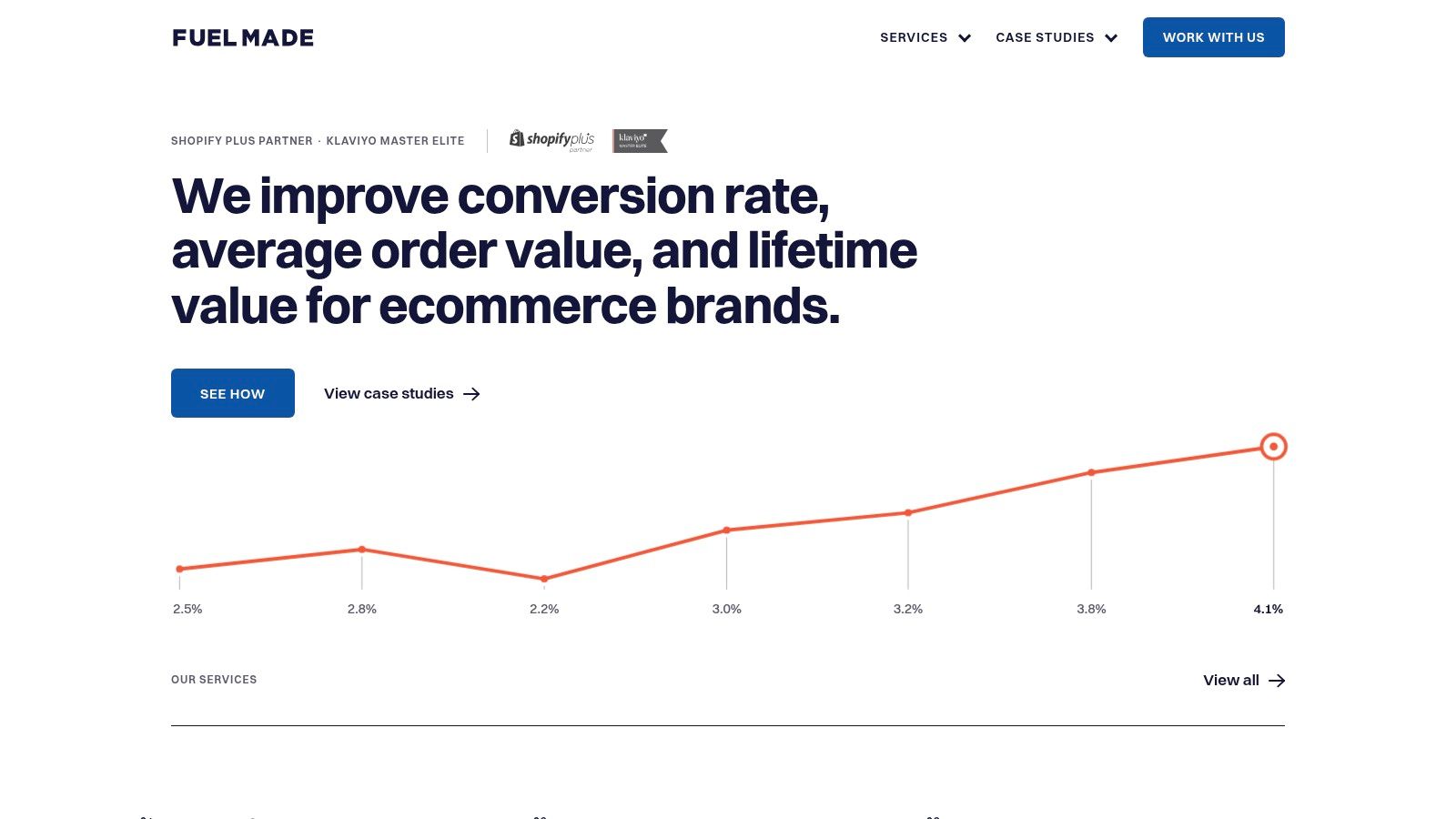
Fuel Made is a strong pick when the main problem isn't just getting live, it's making the post-launch store perform. The agency's profile makes sense for DTC brands that want Shopify Plus development tied tightly to lifecycle marketing and conversion work.
<a id="good-for-growth-led-execution"></a>
Good for growth-led execution
The value proposition is straightforward. Fuel Made combines build work with Klaviyo expertise, which is useful if your ecommerce team wants the site and the retention program moving in the same direction. That's a more practical setup than handing the store to one vendor and email or SMS to another, then trying to reconcile priorities after launch.
Here the trade-off shows up. A boutique agency built around growth and CRO can be excellent for DTC execution, but it may not be the right choice if your roadmap is dominated by deep ERP work, B2B edge cases, or unusually heavy systems integration. Those projects usually need broader enterprise governance than a growth-first team can provide on its own.
What works well
- Store plus retention in one team: Helpful when conversion work depends on email and SMS flows.
- Hands-on delivery: Good for merchants that want less strategy theater and more actual implementation.
- CRO-minded builds: Useful if the brief includes checkout, PDP, and funnel improvements.
What to pressure-test
- B2B complexity: Ask directly how they handle trade pricing, approvals, and back-office integrations.
- Budget fit: This is not the place for a bare-minimum build.
- Systems depth: Make sure the team can show real integration patterns, not just app recommendations.
Fuel Made is strongest when growth and engineering need to move together. If your team already knows the brand problem and wants a partner to execute tightly, it belongs in the conversation.
Website: Fuel Made
<a id="5-blueswitch"></a>
5. BlueSwitch
BlueSwitch is built for merchants that care about wholesale, B2B workflows, and systems integration as much as storefront design. If your team sells across trade and direct channels, that matters more than a glossy homepage.
<a id="strong-b2b-and-hybrid-commerce-fit"></a>
Strong B2B and hybrid commerce fit
The agency's positioning around bulk ordering, backend integrations, and documented Plus migrations tells you where it's comfortable. This is the kind of partner that can deal with operational complexity without pretending a consumer-first template will solve wholesale requirements. That's important because B2B projects fail when teams underestimate the amount of account structure, approval logic, and integration work hiding behind “just put it on Shopify Plus.”
For buyers, the benefit is focus. A specialist B2B agency is usually better than a generalist when the project needs catalogs, pricing rules, and backend reliability to work together. The downside is that the same specialization can be more than you need if your business is simple DTC and the technical requirements are light.
If you're validating a partner at this level, use United Victory Technologies' Shopify migration readiness checklist as your internal benchmark. It's a good way to keep the conversation grounded in dependencies, not slide decks.
A partner that understands B2B flow should be able to explain how it handles customers, pricing, inventory, and order events without hand-waving.
BlueSwitch is a strong option when wholesale is a core part of revenue and the Shopify Plus project has to reflect that from day one. It's less compelling if you're just looking for a prettier DTC rebuild.
Website: BlueSwitch
<a id="6-verbalvisual"></a>
6. Verbal+Visual
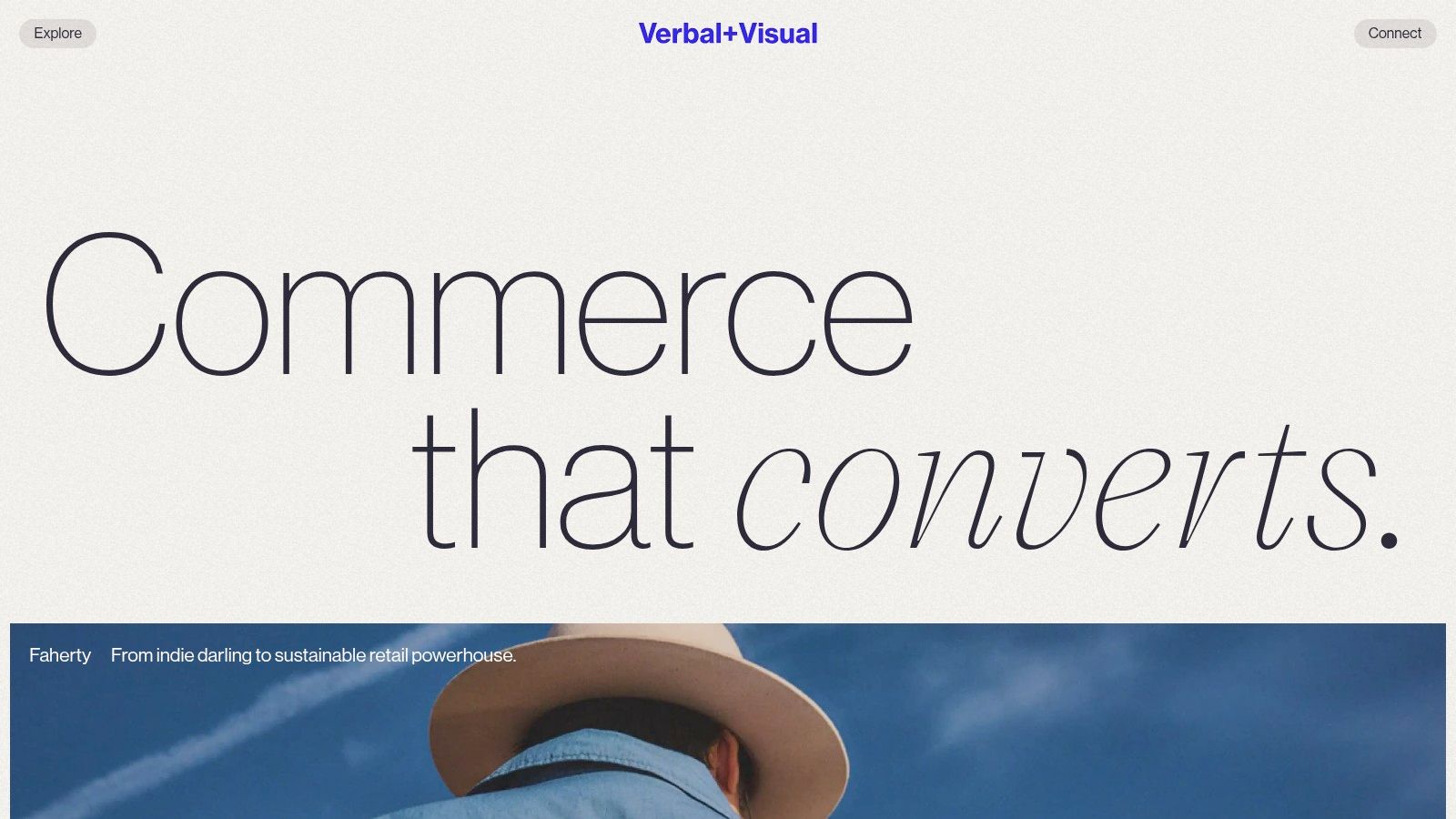
Verbal+Visual fits fashion and lifestyle brands that need international readiness without losing a premium feel. The stronger signal is its mix of storefront aesthetics, replatforming, and operational support, because that combination is where many brand-led agencies fall short.
<a id="best-when-the-brand-is-global-and-visual"></a>
Best when the brand is global and visual
Its experience with SFCC-to-Shopify Plus migrations, international expansion, and POS setup points to a team that can handle more than page design. That matters when a brand operates across markets, channels, and store systems, and the site has to function as a digital flagship, not just a checkout path.
The fit is narrower than some of the others on this list. If the project is B2B-first, or if the main issue is ERP sync and wholesale architecture, a partner with deeper back-office focus may be a better fit. If the work is driven by luxury positioning, visual merchandising, and rollout across regions, Verbal+Visual looks more relevant.
Premium retail teams should ask whether the agency can preserve brand expression while still making operational trade-offs explicit.
That question matters because beautiful commerce work can hide weak ownership of migration scope. A good partner will explain where it can help with internationalization and where a business process needs to be simplified before launch. What a Shopify migration actually costs is a useful benchmark for that scope conversation.
Website: Verbal+Visual
<a id="7-arctic-grey"></a>
7. Arctic Grey
Arctic Grey is the most obviously high-volume option in this group. It's built for merchants that want broad Shopify coverage, from net-new builds to replatforming and app development, with enough delivery muscle to handle many moving parts at once.
<a id="breadth-speed-and-app-capability"></a>
Breadth, speed, and app capability
The attraction here is scale. Arctic Grey's public directory presence and stated support for a large store base signal a partner that has seen a lot of operating patterns, not just one or two premium-luxury use cases. Its willingness to build public and private Shopify apps is also useful when a merchant wants to solve a gap without stacking yet another third-party tool on top.
That said, breadth comes with a style trade-off. A high-volume, productized agency can move quickly and cover a lot of ground, but it may feel less bespoke than a smaller design studio if your brand needs art-direction-heavy work. The faster the optimization pitch, the more you should ask how the agency prioritizes, tests, and documents changes before signing off.
The best use case here is a complex merchant that wants both site improvements and complementary app development under one roof. The weakest use case is a brand that mainly wants a highly custom creative partner to obsess over every visual detail.
Fast iteration is useful only when the team can explain what gets tested, what gets monitored, and what gets rolled back if it underperforms.
Arctic Grey earns a place on the list because it can bridge implementation, optimization, and app work in one place. That's valuable when internal teams want fewer vendors and quicker decision-making.
Website: Arctic Grey
<a id="shopify-plus-agencies-7-agency-comparison"></a>
Shopify Plus Agencies, 7-Agency Comparison
| Agency | 🔄 Implementation complexity | ⚡ Resource requirements | 📊 Expected outcomes | 💡 Ideal use cases | ⭐ Key advantages |
|---|---|---|---|---|---|
| United Victory Technologies | High, structured, cross‑stack rebuilds (data-safe migrations) | High, mid-market/enterprise budgets; integration ownership needed | Measurable business lifts (e.g., +34% CVR, ~98% organic retention, −41% TCO, +12% AOV) | Migrating from Magento/SFCC/BigCommerce → Shopify Plus; B2B/hybrid catalogs with ERP/PIM needs | ⭐ Deep Shopify specialization; end‑to‑end migrations & CRO; NDA/embedded team |
| We Make Websites | Medium‑High, design-led replatforms and theme builds | High, premium agency fees; access to app ecosystem required | Brand-forward stores with strong performance and conversion improvements | Mature DTC/omnichannel brands seeking premium design + performance | ⭐ Proven design quality; mature partner network for faster integrations |
| Diff | High, enterprise governance and consultative delivery | High, longer timelines and larger program budgets | Robust, scalable Shopify Plus implementations for large catalogs | Large retailers/omnichannel brands needing rigorous program management | ⭐ Platinum partner; enterprise delivery rigor and CRM retention capabilities |
| Fuel Made | Medium, integrated UX, CRO and development workflow | Medium, boutique team; aligned marketing/dev resources | Conversion and LTV uplift via CRO + lifecycle marketing | DTC brands prioritizing email/SMS (Klaviyo) and rapid growth experiments | ⭐ Strong CRO + Klaviyo alignment; hands‑on execution focus |
| BlueSwitch | High, B2B workflows, bulk ordering and complex integrations | High, enterprise/B2B resource needs and longer engagements | Scalable B2B/B2C storefronts with improved wholesale workflows | Wholesale, B2B or hybrid merchants requiring custom B2B features | ⭐ B2B specialization; documented Plus migrations and integrations |
| Verbal+Visual | Medium, creative, internationalized storefront builds | Medium‑High, premium quoting for bespoke design work | High‑quality flagship experiences and international expansion support | Fashion and lifestyle brands seeking art‑directed commerce sites | ⭐ Strong creative + conversion balance; public case studies |
| Arctic Grey | Medium‑High, productized large-scale replatforms and app builds | Medium‑High, supports high volume, app development and ERP work | Fast iterations, unified commerce and custom app solutions | High-volume merchants needing enterprise integrations and apps | ⭐ Platinum partner; broad scale experience and app‑building capability |
<a id="turning-this-shortlist-into-a-confident-partner-decision"></a>
Turning This Shortlist Into a Confident Partner Decision
The fastest way to separate strong shopify plus agencies from polished sales decks is to send the same brief to every team on your shortlist. Keep the brief specific. Include your checkout requirements, B2B or wholesale pricing rules, market and currency plan, ERP, PIM, or CRM systems, and the migration timeline you're working against.
Then ask for a scoped plan that covers redirect mapping, data migration, and post-launch support. The answer you want is not “yes, we do that.” You want to see how each agency thinks about record reconciliation, validation, rollback, release control, and ownership after launch. The quality of that answer tells you more than a homepage ever will.
Use the same lens for every proposal. Checkout extensibility should be clear. Multi-region setup should be explicit. Migration and integration risk should be handled as delivery work, not as a promise that the platform will somehow absorb complexity by itself.
This is also where the fit becomes obvious. Some agencies are better at brand-led design. Others are better at B2B logic, systems integration, or growth execution. The wrong choice is the one that looks strongest in a case-study reel but can't describe the operational handoff in plain language.
If you want a partner that starts with data integrity, SEO continuity, and integration discipline, then keeps working after launch, United Victory Technologies is worth a serious look. The team builds Shopify and Shopify Plus programs for merchants that need the migration done properly, then supported with ongoing development and CRO. Visit United Victory Technologies to request a migration assessment and see whether the fit is right for your store.