
7 Shopify Migration Experts for Replatforming in 2026
Compare 7 Shopify Migration Experts on methodology, SEO redirects, integrations, and proof points, plus tips for choosing the right replatforming partner.
You've outgrown your current platform, the new Shopify theme looks clean in staging, and go-live feels like the finish line. Then organic sessions slide week after week, returning customers can't sign in, and support can't find old orders. That's the replatform mistake that costs rankings before launch day, because the redirect map and account migration were treated as final checks instead of engineering.
This roundup profiles seven Shopify migration experts with published migration work. I judge them on source platforms they've moved, redirect and B2B pricing method, whether they rebuild for Shopify's section-based themes or copy legacy templates, and what proof they can show. The stakes are real. Shopify's 2025 Form 10-K reports merchants generated $378.4 billion in gross merchandise volume, a 29% increase from $292.3 billion in 2024. You're not moving a brochure site. You're moving revenue, data, and operations into that ecosystem, and your shortlist should reflect it.
Table of Contents
- 1. United Victory Technologies
- 2. Absolute Web
- 3. Swanky
- 4. SDG (Spiegel Design Group)
- 5. We Make Websites
- 6. Robeka
- 7. DoodleWeb
- Shopify migration experts at a glance
- Choosing Your Partner Before You Commit to a Cutover Date
<a id="1-united-victory-technologies"></a>
1. United Victory Technologies
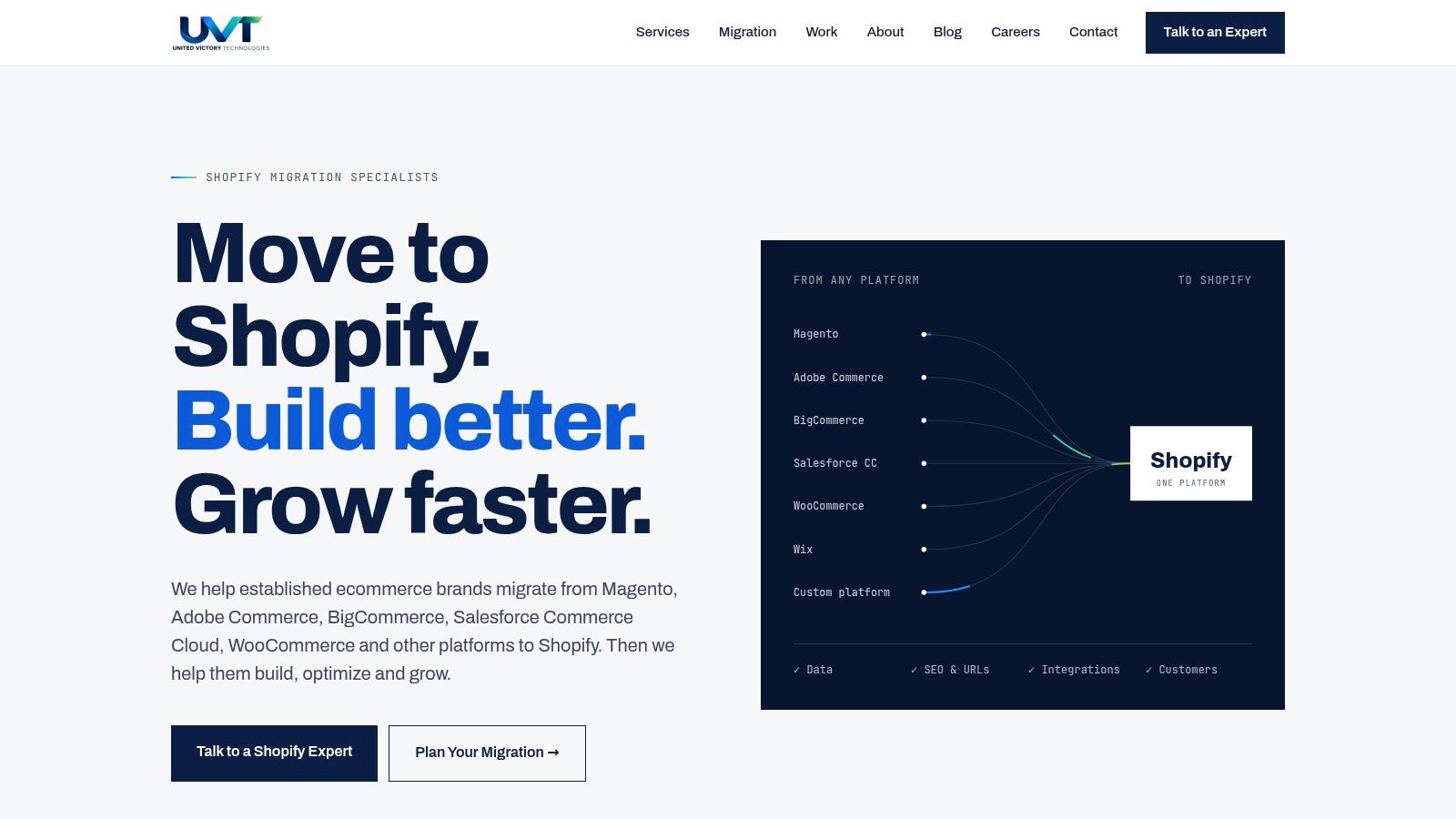
United Victory Technologies, or UVT, is a Shopify Select Partner built for established brands leaving Magento, Adobe Commerce, BigCommerce, Salesforce Commerce Cloud, WooCommerce, Wix, Squarespace, and custom systems for Shopify or Shopify Plus. Its structured process covers products and pricing, customer accounts, order history, content, SEO URLs and redirects, integrations, and international-market requirements. If you're comparing approaches, its guide on how to choose a Shopify migration agency shows the questions it expects buyers to ask.
The defining choice is rebuild, not replicate. Legacy templates rarely map cleanly to Shopify's section-based themes, so UVT rebuilds the experience on Online Store 2.0 instead of copying the old storefront into a new host. That trade-off costs more design thinking up front, but it avoids dragging legacy layout constraints, plugin workarounds, and slow mobile templates into Shopify.
<a id="what-to-verify-in-the-proof"></a>
What to verify in the proof
UVT works under NDA and anonymizes client work by default, so you won't get logos or screenshots. You do get outcome metrics you can interrogate. In one case, a Home and Living retailer with 20k+ SKUs moved from Magento 2 to Shopify Plus with a 34% increase in conversion rate, 1.8s mobile LCP, and 98% organic retention.
- Platform scope: Custom themes, Shopify Plus checkout and B2B architecture, Shopify Markets, and multi-region catalogs.
- Integration scope: ERP, CRM, PIM, and OMS connections scoped as part of migration, not after it.
- Post-launch scope: CRO, analytics, and ongoing development from an embedded team that stays after launch.
Practical rule: If a partner can't explain which system owns price, inventory, and customer eligibility after cutover, the storefront design doesn't matter yet.
Pricing isn't published, so scope requires a direct assessment. I recommend UVT first when data integrity, redirect governance, and integrations matter as much as the theme, and when you can evaluate anonymized metrics instead of needing a named portfolio.
<a id="2-absolute-web"></a>
2. Absolute Web
Start with the published project, not the service menu. Absolute Web documents a Glo Skin Beauty move from Magento to Shopify Plus that consolidated U.S. and Canadian stores while handling B2B pricing, SEO, content, and custom functionality. That combination tells you more than a generic migration claim because multi-market consolidation forces hard decisions on catalogs, price lists, domains, and content ownership.
The agency is U.S. based, with offices in Miami and Los Angeles, and it holds experience across both Shopify Plus and Adobe Commerce. It describes migrations from Magento, Salesforce Commerce Cloud, BigCommerce, WooCommerce, and custom systems. Services extend into custom development, integrations, performance, and CRO, so pre-launch and post-launch work can stay under one contract.
<a id="where-it-fits-and-where-to-push"></a>
Where it fits and where to push
Consider Absolute Web when B2B or multi-market requirements sit at the center of the move. Published work involving WordPress content and custom Magento modules is relevant if your storefront carries years of editorial URLs and bespoke logic that can't be recreated with a standard app.
No standard migration pricing was found. Before signing, confirm the proposed team, not just the agency, has handled your catalog structure and your specific integrations. Ask how B2B price lists will be modeled in Shopify, which records stay authoritative in the ERP, and how U.S. and Canadian URL variants will be redirected and monitored after consolidation. Vague answers there predict operational drift later.
<a id="3-swanky"></a>
3. Swanky
If you're leaving Magento, Swanky has the clearest source-specific story in this group. Its Natural Instinct case study describes a Magento Enterprise to Shopify Plus migration connected to Sage ERP, and other published work covers large customer and order datasets, B2B requirements, and Shopify's native B2B features. That's the right kind of evidence, because Magento exits usually fail on attribute mapping and back-office sync, not on theme build.
Its structured process runs through discovery, data, integrations, development, redirects, testing, and launch. It describes using tools such as Matrixify for bulk data imports, which is sensible for large catalogs if validation follows the import. Migration can combine with redesign, systems integration, and post-launch support.
A bulk import tool moves records. It doesn't decide which Magento attributes become Shopify options, which become metafields, and which should be retired.
The trade-off is focus. Reviewed evidence is strongest for Magento 1 and 2, so merchants leaving BigCommerce or Salesforce Commerce Cloud should request comparable examples. For broader context on Plus specialists, compare this profile against a roundup of Shopify Plus agencies before you commit.
No public project pricing was found. I recommend Swanky most confidently for a Magento replatform where B2B workflows need rethinking during the move, rather than recreated one for one.
<a id="4-sdg-spiegel-design-group"></a>
4. SDG (Spiegel Design Group)
Broad source coverage is the reason to call SDG. The Los Angeles agency describes migration work from Magento, Salesforce Commerce Cloud, Oracle ATG, Adobe Experience Manager, BigCommerce, WooCommerce, and custom platforms. That list matters for enterprise teams whose legacy stack isn't a clean single platform, but a storefront tied to content and operational systems.
SDG states that its planning considers data, redirects, content, integrations, analytics, and cutover together. That framing is correct. A Classy Llama replatforming playbook found 76% of respondents identified data security as their biggest migration challenge, with integration bottlenecks and manual reconciliation also recurring. A partner that scopes only the theme leaves that risk untouched.
- Delivery model: In-person working sessions in Los Angeles, plus remote delivery across the U.S. and internationally.
- Service span: Design and development, migrations, integrations, headless builds, SEO, CRO, and ongoing support.
- Project span: Enterprise replatforms and smaller engagements.
No public project pricing was found. Because the claimed platform range is wide, ask for a directly relevant case study and references for your exact migration type. Breadth helps only if the team assigned to you has done your move before.
<a id="5-we-make-websites"></a>
5. We Make Websites
Some migrations should copy as little as possible. We Make Websites suits that brief because it pairs Shopify Plus replatforming with UX and UI design and theme development. Its published Norwood case study documents a Magento to Shopify Plus move combined with a redesign, internationalization, data migration, Shopify Markets, and a modular storefront.
That combination is valuable when the legacy experience itself is the problem. Copying a dated Magento template into Shopify preserves the friction you were trying to escape. A modular rebuild lets merchandisers launch region-specific content without queuing behind developers, which is often the operational gain that justifies replatforming.
<a id="what-the-norwood-evidence-proves"></a>
What the Norwood evidence proves
The case provides concrete detail on goals and the resulting Shopify setup, including international operations and Markets configuration. It doesn't prove every source platform. Reviewed migration evidence is Magento-specific, so ask for references if you're leaving WooCommerce, BigCommerce, or Salesforce Commerce Cloud.
Use a structured self-check before the first call. A Shopify migration readiness checklist helps you separate data, integration, and design scope so redesign ambitions don't crowd out redirect and account work.
No public migration pricing was found. I recommend this agency when redesign and international rollout are genuine requirements, not decorative extras added to a data move.
<a id="6-robeka"></a>
6. Robeka
Catalog size changes the migration method, and Robeka publishes an example that speaks to it. The Florida-based agency describes a Magento to Shopify Plus migration involving a catalog of more than 10,000 SKUs, with catalog and customer data, redirects, and launch quality assurance in scope. It also describes migrations from BigCommerce.
Services cover Shopify themes, Shopify Plus, custom apps, headless and Hydrogen builds, and integrations. ERP and CRM integration is offered alongside migration, and post-launch maintenance includes performance and conversion optimization. For a merchant without an internal Shopify developer, one partner for the move and the following releases can reduce handoff loss.
Hold the proof to a higher standard, though. Published results are self-reported, so request references and project-specific evidence at your SKU count. Ask who validates imported variants against source records, how discontinued products are redirected, and what happens when a customer record or order doesn't reconcile.
Cutover test: Ask how orders placed during the final sync window get captured. A credible team describes the catch-up pass without being prompted.
No public project pricing was found. Consider Robeka for a Shopify-focused migration where larger-catalog handling and post-launch optimization matter, provided references confirm the published example is comparable to your store.
<a id="7-doodleweb"></a>
7. DoodleWeb
DoodleWeb is a Seattle-based Shopify Plus agency positioned for North American merchants. It describes migrations from Magento 2, WooCommerce, BigCommerce, and legacy platforms, with products, orders, and SEO among the items it aims to preserve. It presents its focus as Shopify Plus, DTC, B2B, and enterprise commerce.
That positioning can suit a North American team that wants migration and ongoing Shopify management from one U.S. based partner. Time-zone alignment sounds minor until launch week, when a broken webhook or missing redirect batch needs same-day decisions from merchandising, operations, and development together.
The limitation is evidence depth. Reviewed information is primarily agency-provided, without the same published case detail as some entries above. That doesn't disqualify the firm, but it shifts the burden to your diligence.
- Ask for named proof: Request case studies from your source platform and client references you can call.
- Ask for method: Confirm how order history, SEO fields, and B2B accounts are mapped and validated.
- Ask for ownership: Confirm who manages the store after launch and what that support includes.
No public migration pricing was found. I recommend shortlisting DoodleWeb when U.S. based Plus focus and ongoing management matter, then letting references decide.
<a id="shopify-migration-experts-at-a-glance"></a>
Shopify migration experts at a glance
| Item | Location | Migration Sources | Best For |
|---|---|---|---|
| United Victory Technologies | Location not specified | Magento, Adobe Commerce, BigCommerce, Salesforce Commerce Cloud, WooCommerce, Wix, Squarespace, custom systems | Complex Shopify or Shopify Plus migrations, integrations, SEO preservation, and ongoing growth |
| Absolute Web | Miami and Los Angeles, United States | Magento, Salesforce Commerce Cloud, BigCommerce, WooCommerce, custom systems | Complex B2B or multi-market migrations |
| Swanky | Location not specified | Magento 1 and 2 | Magento migrations involving B2B workflows, ERP connections, or large datasets |
| SDG (Spiegel Design Group) | Los Angeles, United States | Magento, Salesforce Commerce Cloud, Oracle ATG, Adobe Experience Manager, BigCommerce, WooCommerce, custom platforms | Enterprise replatforming and Southern California teams seeking in-person collaboration |
| We Make Websites | Location not specified | Magento | Migrations combined with redesigns or international expansion |
| Robeka | Florida, United States | Magento, BigCommerce | Shopify migrations with larger catalogs, integrations, and post-launch optimization |
| DoodleWeb | Seattle, United States | Magento 2, WooCommerce, BigCommerce, legacy platforms | North American merchants seeking Shopify Plus migration and ongoing management |
<a id="choosing-your-partner-before-you-commit-to-a-cutover-date"></a>
Choosing Your Partner Before You Commit to a Cutover Date
Shortlist two or three Shopify migration experts and test each against the same checklist. Don't let one agency sell design while another sells data migration and then compare prices as if the scopes match. Put your source platform, catalog size, integrations, B2B rules, markets, and retention targets in one brief, and require every bidder to answer it line by line.
SEO continuity deserves the hardest questions. Google's Search Central site move guidance instructs owners to prepare a URL mapping, use permanent 301 or 308 redirects where possible, avoid chains, submit the new sitemap, and keep redirects for at least one year. It recommends keeping chains to no more than 3 and fewer than 5. Ask to see a sample mapping, a chain test, and the post-launch monitoring cadence.
The recovery cost of getting this wrong is not a bad week. An analysis of 892 domain migrations found sites took an average of 523 days to recover prior organic traffic, while 17% had not recovered after 1,000 days. Baseline your rankings, landing pages, crawl coverage, and conversion rates before cutover, then set escalation thresholds for missing redirects, indexation errors, and revenue loss.
Judge platform claims with the same discipline. J.D. Power's 2025 U.S. Merchant Services Satisfaction Study ranked Shopify highest for small-business merchant-services satisfaction with a score of 711, from 3,841 customers surveyed. That's merchant services, not proof your enterprise integration will be painless. Use it as a benchmark category, then measure your own proof of concept against ERP sync, checkout incidents, support tickets, and release-blocking defects.
Finally, verify operational truth. Require a field-level ownership matrix for price, inventory, customer eligibility, and order status, replayable integration tests, reconciliation reports, and a rollback plan. Decide which order history must be searchable in Shopify and what stays in the legacy system during transition.
If you want a realistic starting point, we offer a Shopify Migration Readiness Assessment with eight questions that takes about two minutes and gives a scoped view of data, integrations, SEO risk, and timeline. Take it, then request a Migration Assessment for your current stack before you choose a partner or promise the business a launch date.
If you're weighing a move from Magento, BigCommerce, WooCommerce, Salesforce Commerce Cloud, or a custom platform, we can scope the data, redirects, integrations, and Shopify Plus build before you commit to a cutover date. Visit United Victory Technologies to request a migration assessment and get a realistic plan for protecting revenue through launch.