7 Shopify Plus Agency Picks for 2026: Who to Hire
Compare 7 Shopify Plus agency options for 2026, with notes on checkout extensibility, B2B, and ERP integrations, plus a checklist for choosing a partner.
You're running an ERP, a wholesale price book, and a Magento catalog with 15,000 SKUs, and three agencies have quoted you for Shopify Plus. One proposal is mostly theme work. Another leads with integrations. A third promises checkout gains without explaining who'll map your redirects, price lists, or expansion stores. They aren't quoting for the same job.
That's why a Shopify Plus agency shortlist has to start with store profile, not logos. Plus work usually means checkout extensibility, B2B companies and locations, Shopify Functions for discount, shipping, and payment rules, and decisions about Markets versus expansion stores. The stakes aren't trivial either. Shopify's fiscal 2025 annual filing reports approximately $378.4 billion in platform GMV for 2025, and says the majority of GMV comes from merchants using Shopify Plus and other enterprise offerings, even though most merchants subscribe to Basic and Grow.
This list matches seven agencies to specific jobs, ERP heavy B2B, enterprise omnichannel, Magento or Salesforce replatforms, and multi-region DTC. It weighs Shopify directory evidence and pricing transparency, and treats review counts as small samples, not proof. One entry is United Victory Technologies, so apply the same scrutiny to it as to every other name here.
Table of Contents
- 1. United Victory Technologies
- 2. Uncap
- 3. Netalico
- 4. Avex
- 5. Anatta
- 6. Third and Grove
- 7. Domaine
- How the seven Shopify Plus agencies compare on best-fit use case, partner status, directory reviews, and pricing transparency
- Turn the Shortlist Into a Scoped Request
<a id="1-united-victory-technologies"></a>
1. United Victory Technologies
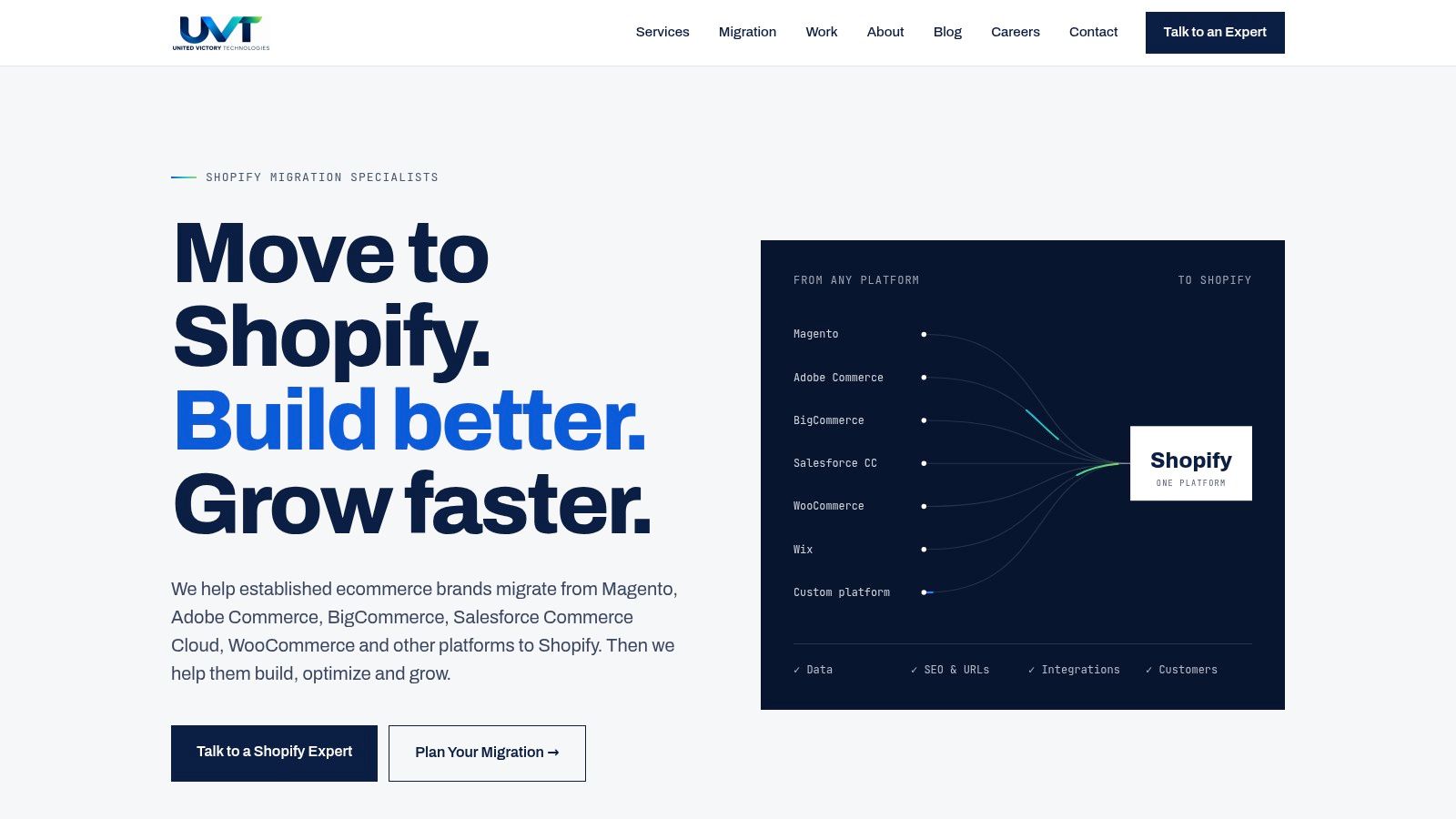
United Victory Technologies is a Shopify Select Partner built around one core job, moving established brands from Magento, Adobe Commerce, BigCommerce, Salesforce Commerce Cloud, WooCommerce, and custom platforms to Shopify or Shopify Plus without losing the data and search equity that fund the business. I would put UVT on the list for mid-market, multi-region catalogs where migration risk is the main risk, not for a brand that only needs a visual refresh. You can review the scope on the United Victory Technologies website.
The migration process is structured rather than lift and shift. It covers products, customers, orders, and content, plus SEO URLs and redirect maps, integrations, and international market requirements. UVT rebuilds the experience for Shopify's section based themes instead of copying legacy templates, which matters because a Magento layout forced into Liquid usually leaves merchants with hard coded pages their team can't edit.
<a id="what-the-evidence-supports"></a>
What the Evidence Supports
Because every engagement is under NDA, case studies are anonymized, and that's a real trade-off. You won't get named references, logos, or screenshots to inspect in public. What you do get are reported outcomes you should interrogate in an assessment. In one case, a Home and Living retailer with 20k+ SKUs moved from Magento 2 to Shopify Plus with a 34% increase in conversion rate, 1.8s mobile LCP, and 98% organic retention. An apparel DTC brand moving from Salesforce Commerce Cloud reported 41% lower platform total cost of ownership and a 12% increase in average order value.
Beyond launch, UVT builds editable Online Store 2.0 themes, Plus and B2B functionality, and ERP, CRM, PIM, and OMS integrations. It also offers checkout extensibility, Functions, expansion stores, and custom functionality such as configurators, bundles, and custom checkout logic. Ongoing development and evidence based CRO cover funnel analysis, product pages, navigation, and A/B testing.
Practical rule: If confidentiality blocks public proof, ask for the migration method in writing, redirect sampling, data reconciliation, and rollback criteria, before you accept any outcome claim.
Pricing isn't published. UVT scopes work through migration assessments and store audits, including a free Store Audit for stores already on Shopify and an option for enterprise clients to talk to a Shopify Expert. That's reasonable for complex replatforms, but it means you can't budget from the website alone.
<a id="2-uncap"></a>
2. Uncap
Start with your ERP, not your homepage, if you're considering Uncap. This Chicago based agency focuses on B2B, manufacturing, distribution, and complex commerce, and its directory profile identifies it as a Platinum Partner. That positioning is narrower than a general DTC studio, and for the right merchant, narrower is better. Details are on the Uncap website.
The strongest evidence is operational. Uncap's directory work documents connections with Epicor, Infor, and Microsoft Dynamics, including a B2B implementation supporting more than one million SKUs. For a distributor, that kind of catalog and price book complexity is the project. Storefront polish won't fix a broken company, location, and payment terms model.
<a id="where-uncap-fits-best"></a>
Where Uncap Fits Best
Shopify Plus gives this work a specific technical edge. Shopify's B2B ecommerce guidance describes Plus supporting unlimited catalogs and direct catalog assignments to individual companies or company locations, while lower tier B2B configurations are limited to up to three active catalogs through Markets. An agency still has to normalize your legacy organizations into companies, locations, users, price lists, and tax and shipping rules. Unlimited catalogs don't clean up bad customer master data for you.
Uncap also handles migrations, custom app and quote request functionality, and unified commerce across wholesale, DTC, POS, and subscriptions. Its Shopify directory shows a 5.0 rating from 66 reviews, which is the largest review sample on this list, though still not a guarantee for your ERP.
The trade-offs are clear. Pricing is quote based and not published in the directory, so you can't compare cost without a scoped conversation. And if your main need is creative led DTC brand design, a manufacturing and B2B specialist may not be the most economical fit.
<a id="3-netalico"></a>
3. Netalico
Netalico suits a merchant who wants the migration and the relationship after it handled by the same US based team. It moves stores from Magento, BigCommerce, WooCommerce, and custom systems, with attention to data, SEO continuity, URL redirects, and project management. You can see its services on the Netalico website.
That post-launch angle matters more than most replatform proposals admit. Launch week exposes redirect gaps, app conflicts, and analytics breaks that staging didn't catch. Netalico offers development, CRO, UX, and ongoing support through retainers as well as project work, so it's a plausible fit for mid-market teams without in-house Shopify developers. If you're comparing delivery models, this breakdown of what a Shopify Plus web development company should actually cover helps separate build work from ongoing ownership.
<a id="evidence-and-pricing"></a>
Evidence and Pricing
- Directory rating: Shopify shows 5.0 from 15 reviews, a positive but small sample.
- Named case studies: Directory examples include migrations for Big Green Egg, Audio Advice, and Crossrope, which gives you something concrete to ask about.
- Published guidance: Netalico publishes project and retainer pricing guidance on its website, which is more transparency than most agencies here offer.
That guidance isn't a binding quote, and scope will move the number. A straightforward WooCommerce move won't price like a custom platform with years of order history and bespoke integrations. Netalico's service level may also be excessive for a very small store that could launch on a standard plan with light theme work.
I would shortlist Netalico for established mid-market merchants who value SEO conscious migration plus a continuing development partner. I wouldn't choose it on review score alone.
<a id="4-avex"></a>
4. Avex

For a brand replatforming from Salesforce Commerce Cloud or connecting Shopify to SAP, Avex's directory profile offers relevant project signals. The agency is listed as a Platinum Partner, with migration, systems integration, international expansion, and CRO among its services. Its process covers discovery, data architecture, URL mapping, integrations, feature rebuilding, and performance testing. Details are available on the Avex website.
The directory names Salesforce Commerce Cloud migration and SAP integration work, as well as projects for quip and Novus Shoes. Those examples are more useful than partner status alone when assessing fit for an integration-heavy store. For context on what Shopify partner tiers indicate, see this guide to Shopify Partner tiers.
<a id="read-the-review-count-carefully"></a>
Read the Review Count Carefully
A perfect score from a handful of reviewers shows those clients were satisfied. It does not establish how an agency handles a failed integration at scale.
Avex has a 5.0 rating from 4 reviews in Shopify's directory. That is a small sample. Ask for a reference with a comparable integration stack, and use the named projects as starting points for questions about delivery and support.
Shopify reported $11.6 billion in total revenue, up approximately 30% year over year, and GMV growth of about 29% in its fiscal 2025 results release. These figures show platform growth, not whether a particular migration is a good fit. Avex's directory lists a $10,000 starting price for selected services; that figure is not a full migration estimate, so request a scoped quote for your systems and requirements.
<a id="5-anatta"></a>
5. Anatta
Anatta is built for a different scale of problem. Think large omnichannel retailers that need an embedded cross-functional team for sustained engineering, not a one off store build. It's a Platinum Partner, says it has focused exclusively on Shopify since 2014, and highlights work involving buybuy BABY, Vuori, and Rothy's in its directory profile. See the Anatta website for its enterprise positioning.
Its offer covers enterprise migration, Plus development, checkout upgrades, ongoing engineering, and optimization across omnichannel and international programs. Checkout is where you should press for specifics. Shopify's enterprise checkout analysis reports that an independent global management consultancy found Shopify's overall checkout conversion rate exceeded competing platforms by an average of 15.2%. Treat that as a directional benchmark, not a promised uplift for your traffic mix, geography, or payment methods.
<a id="questions-to-ask-anatta"></a>
Questions to Ask Anatta
- Baseline first: Will the team segment conversion by device, country, customer type, and payment method before changing checkout?
- Guardrails: Will tests track payment failures, refunds, and support contacts alongside revenue per session?
- Ownership: Who owns releases and experiment governance after launch?
Directory case studies provide specific client context, which helps. But the profile has no reviews yet, pricing is contact based, and an enterprise delivery model may exceed mid-market budgets. If you're weighing that investment, this framework for choosing a Shopify development company by fit and risk can help you score proposals consistently.
<a id="6-third-and-grove"></a>
6. Third and Grove
Say you're a beauty, CPG, apparel, footwear, or outdoor brand where content and commerce are tangled together. Your blog, buying guides, and product pages drive revenue as one system. That's the scenario where Boston based Third and Grove, a Shopify Platinum Partner, becomes interesting. Its services are listed on the Third and Grove website.

The agency combines Shopify builds and migrations with CMS expertise, creative strategy, integrations, audits, performance work, and ongoing management. That mix can reduce vendor handoffs. You don't need one firm redesigning templates while another discovers the integration or content model can't support them. Fewer handoffs usually means fewer decisions lost between discovery and build.
<a id="what-is-documented-and-what-is-not"></a>
What Is Documented and What Is Not
The Shopify directory lists migration and app or integration development services. Portfolio evidence includes multi-site migration work for Titan Brands, which is relevant if you're consolidating several properties or untangling a multi-brand setup. A named multi-site project is a better starting point for diligence than a generic claim about scalability.
The gaps are pricing and reviews. Shopify's directory currently shows no reviews, and pricing is quote based with no typical project budget established there. That doesn't disqualify the agency, but it shifts the burden onto references and a scoped proposal. Ask how audits translate into a prioritized backlog, who owns performance budgets, and what ongoing management includes each month.
I would consider Third and Grove when creative, content, and technical work overlap. For a purely ERP driven B2B replatform, other profiles on this list show more direct evidence.
<a id="7-domaine"></a>
7. Domaine
Domaine is a Shopify Platinum Partner with a US presence and a broad design and development practice. It offers migrations, custom apps and integrations, checkout upgrades, and ongoing management. For complex enterprise replatforms, breadth can help, provided the team assigned to you matches the work in the case studies. Start with the Domaine website.

Its directory highlights projects moving Arhaus from a complex custom platform and Laura Mercier from Salesforce Commerce Cloud to Shopify Plus, plus multi-region work for Timex. Those three examples cover the hard cases well, bespoke code retirement, enterprise platform exit, and international operations. If you're leaving Salesforce or a custom stack, ask Domaine to walk you through data architecture and feature rebuilding on a comparable project.
The US profile also lists support for the US, Canada, and the UK. Domaine runs a separate Studio practice for emerging to mid-market brands, which may suit smaller scopes better than the enterprise team. Confirm which practice you're buying before you compare proposals.
<a id="pricing-caveats"></a>
Pricing Caveats
US enterprise pricing is contact based. Pricing shown on other regional or sub-brand listings may not apply to a US enterprise project, so don't import a number from a different listing into your budget. A broad practice may also be more than you need for a narrowly scoped theme refresh.
Domaine fits best when replatforming and multi-region complexity drive the decision. Its directory project evidence is among the most specific here, even without a review led argument.
<a id="how-the-seven-shopify-plus-agencies-compare-on-best-fit-use-case-partner-status-directory-reviews-and-pricing-transparency"></a>
How the seven Shopify Plus agencies compare on best-fit use case, partner status, directory reviews, and pricing transparency
| Item | Best for | Shopify partner status | Directory reviews | Pricing |
|---|---|---|---|---|
| United Victory Technologies | Complex migrations, Shopify Plus, B2B, and ongoing optimization | Select Partner | Not specified | Not publicly listed; scoped through assessment |
| Uncap | B2B, manufacturing, distribution, and ERP-heavy commerce | Platinum Partner | 5.0 from 66 reviews | Quote-based; not published |
| Netalico | Mid-market migrations and ongoing development support | Not specified | 5.0 from 15 reviews | Website pricing guidance; scope-dependent |
| Avex | Enterprise migrations combining technical work, UX, and CRO | Platinum Partner | 5.0 from 4 reviews | Directory selected-services starting price is $10,000; migration estimate varies |
| Anatta | Enterprise and omnichannel programs needing sustained engineering | Platinum Partner | No reviews yet | Contact-based |
| Third and Grove | Consumer brands seeking creative and technical Shopify services | Platinum Partner | No reviews currently | Quote-based |
| Domaine | Complex replatforming and multi-region commerce | Platinum Partner | Not specified | Contact-based for US enterprise projects |
<a id="turn-the-shortlist-into-a-scoped-request"></a>
Turn the Shortlist Into a Scoped Request
A useful proposal starts with the same brief for every agency. Include your current platform, SKU and variant count, order and customer history, ERP, PIM, CRM and OMS systems, B2B pricing rules, subscription or bundle logic, target markets, currencies, languages, and checkout rules the new store must support.
For a migration, ask for an assessment of your current stack and a written redirect mapping plan. The plan should cover how products, customers, orders, content, and URLs will be extracted, transformed, validated, and reconciled. It should also identify who approves data samples, how password migration limits will be handled, and what happens if launch checks fail.
<a id="make-each-agency-commit-to-technical-choices"></a>
Make Each Agency Commit to Technical Choices
Ask for decisions, not just feature lists:
- Checkout extensibility: Which customizations belong in checkout extensions or the Checkout Branding API, and which should be left out?
- Shopify Functions: Which discount, shipping, payment, or validation rules will Functions handle, and how will they be tested across markets?
- B2B structure: How will companies, locations, catalogs, price lists, and payment terms be modeled without duplicating products?
- International setup: When will Shopify Markets suffice, and when are expansion stores a better fit?
- Integrations: Which system is the source of truth for inventory, pricing, and customer records? How will failed syncs be detected?
A proposal should also assign post-launch ownership. Shopify's Shopify versus Salesforce Commerce Cloud comparison describes an architecture built around upgrade-safe extensions, APIs, apps, and Shopify Functions rather than unrestricted changes to a legacy checkout. More extensibility does not automatically improve checkout performance. Each custom rule adds testing across currencies, markets, customer types, and payment methods.
Before you sign: Require a 30-, 60-, and 90-day post-launch control plan that names who owns releases, integration monitoring, data reconciliation, SEO validation, experiment governance, and incident response.
Ask for a reference from a store with a similar catalog and integration burden. Compare proposals by scope, assumptions, exclusions, and post-launch support, not just the quoted total. A lower quote may leave out redirect work, historical data, market-by-market QA, or ongoing integration monitoring.
For a store already on Shopify, United Victory Technologies offers a free Store Audit. For a move from another platform, ask for a Migration Assessment of your current stack. Enterprise clients can also talk to a Shopify Expert. Each step can help clarify the work before you commit to a full build.
If you are moving from Magento, Salesforce Commerce Cloud, BigCommerce, WooCommerce, or a custom platform, start with a migration assessment of your current stack. Then decide with a written plan in hand by visiting United Victory Technologies.