7 Shopify Plus Web Development Company Profiles for 2026
Compare 7 Shopify Plus web development company options for 2026: migration depth, B2B and ERP integration, service models, and pricing transparency.
It's 11 p.m. and you've got seven tabs open. Every Shopify Plus web development company on your screen promises enterprise-grade builds, smooth migrations, and conversion-focused design. The words are nearly identical. The delivery models behind them aren't.
You're probably not shopping for a theme tweak. You're weighing a move off Magento, Adobe Commerce, BigCommerce, Salesforce Commerce Cloud, WooCommerce, or a custom stack, and you can't afford to lose orders, customer data, or organic traffic in the process. That's a reasonable concern. In the commercetools' 2024 replatforming and migration report, 90% reported improved sales or revenue after migration among businesses that had recently changed ecommerce platforms. The upside is real, but it depends on scope, testing, and who owns the work after launch.
The seven profiles below focus on buying fit, not feature lists. Each one covers who the agency appears to serve best, which claims are self-reported, and what you should confirm about migration scope, team ownership, and ERP or PIM work before you ask for a proposal. Read them as shortlisting notes, not rankings.
Table of Contents
- 1. United Victory Technologies
- 2. SDG
- 3. Avex
- 4. Bounteous
- 5. Turnaround
- 6. Simplistic
- 7. Softlimit
- How the seven Shopify Plus agencies differ on best fit, migration focus, and pricing disclosure
- Turning a Shortlist Into a Signed Partner
<a id="1-united-victory-technologies"></a>
1. United Victory Technologies
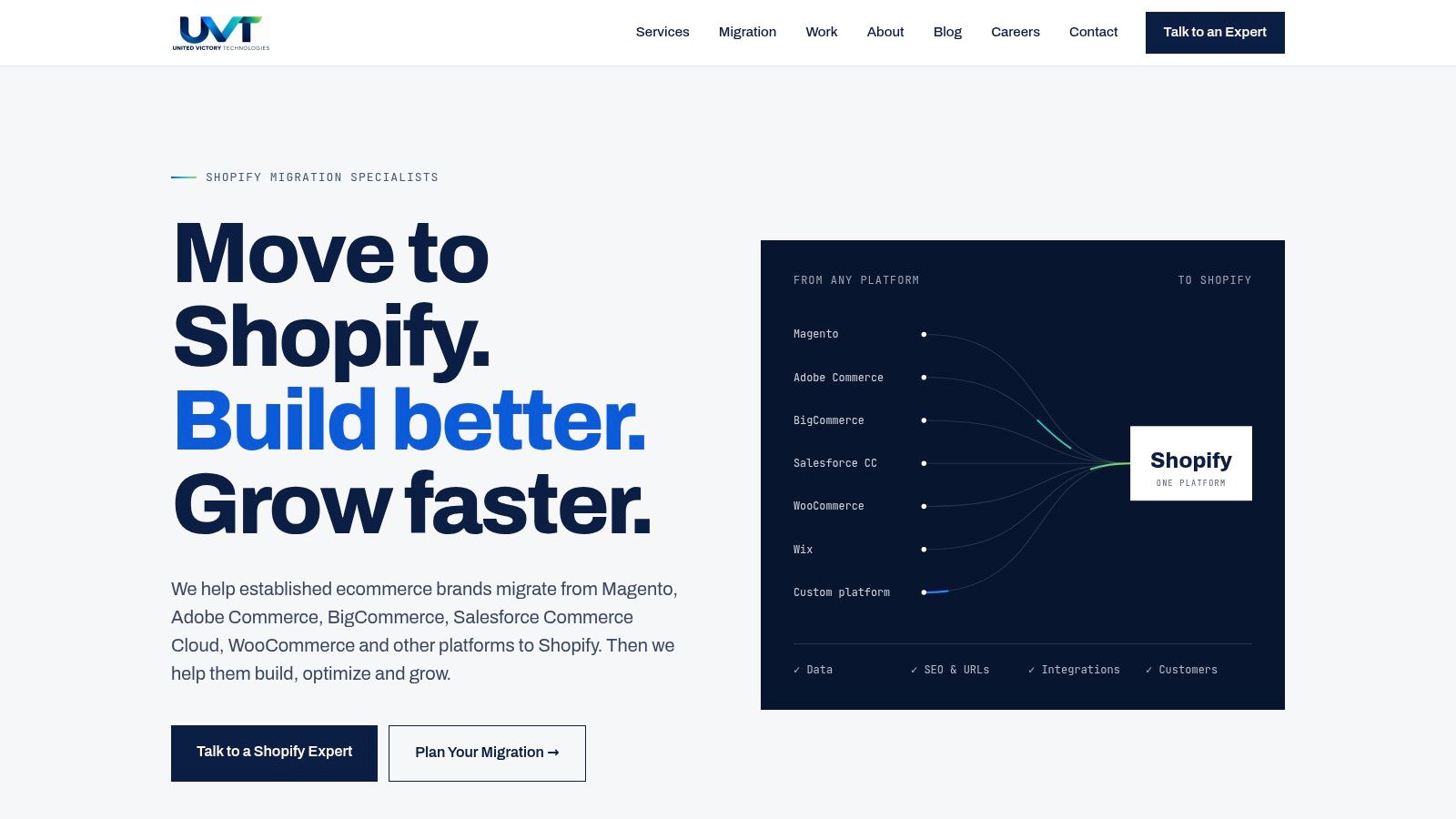
United Victory Technologies builds its offer around one job: moving established brands off Magento, Adobe Commerce, BigCommerce, Salesforce Commerce Cloud, WooCommerce, or a custom platform and onto Shopify. It's a Shopify Select Partner, and the model runs end-to-end, covering migration planning, Shopify and Shopify Plus development, launch testing, and ongoing growth under a single engagement.
That scope matters because Plus work now sits at platform scale. According to Shopify's 2025 annual filing, Shopify facilitated $378.4 billion in gross merchandise volume in fiscal 2025, up 29% from $292.3 billion in 2024, and the same filing states that the majority of platform GMV is generated by merchants subscribing to Shopify Plus and other enterprise offerings. A Plus migration is an operations project. Design is one workstream among several.
<a id="what-the-migration-model-covers"></a>
What the migration model covers
UVT migrates products, customer and order data, content, SEO URLs and redirects, and business integrations, including ERP, CRM, PIM, and OMS. Rather than copying a legacy storefront, the team rebuilds around Shopify's section-based themes, with editable Online Store 2.0 designs, Plus capabilities, B2B features, international commerce, and custom functionality.
Ask two questions before shortlisting. How does your current data model map to Shopify's structure, and who reconciles record counts before launch? And which engineers stay on the account after go-live, since the offer includes an embedded team for post-launch work?
- Structured migration: Products, customers, orders, content, redirects, and integrations get planned together.
- Plus depth: Checkout extensibility, B2B, Functions, and expansion stores sit inside the core offer.
- Post-launch growth: Funnel analysis, UX work, A/B testing, and analytics continue after go-live through an embedded team model.
Practical rule: If an agency can't show you its redirect verification and integration test plan in writing, don't treat its migration timeline as credible.
<a id="claims-to-handle-carefully"></a>
Claims to handle carefully
UVT publishes anonymized, NDA-protected case studies and keeps client names, logos, and screenshots off its site. Outcomes vary by project, so treat any figures you're shown as project-specific results and confirm what's realistic for your catalog through a scoped assessment. Pricing isn't published either, which means a scoped estimate is the only way to compare cost. Enterprise clients can request to talk to a Shopify Expert before committing.
For mid-market brands running multi-region catalogs with ERP or PIM dependencies, this delivery model fits well. If you're comparing delivery models across firms, this breakdown of Shopify Plus agencies and what separates them is a useful companion read. My recommendation: request a migration assessment or store audit first, then judge the written scope over the sales call.
Pros: Structured migrations across SEO, integrations, and international markets. Shopify Select Partner with checkout extensibility and ERP or PIM work. CRO and post-launch support target conversion and total cost of ownership alongside code quality.
Cons: Pricing isn't published. Case studies are anonymized, so you may have limited ability to verify results independently or view named client examples.
<a id="2-sdg"></a>
2. SDG
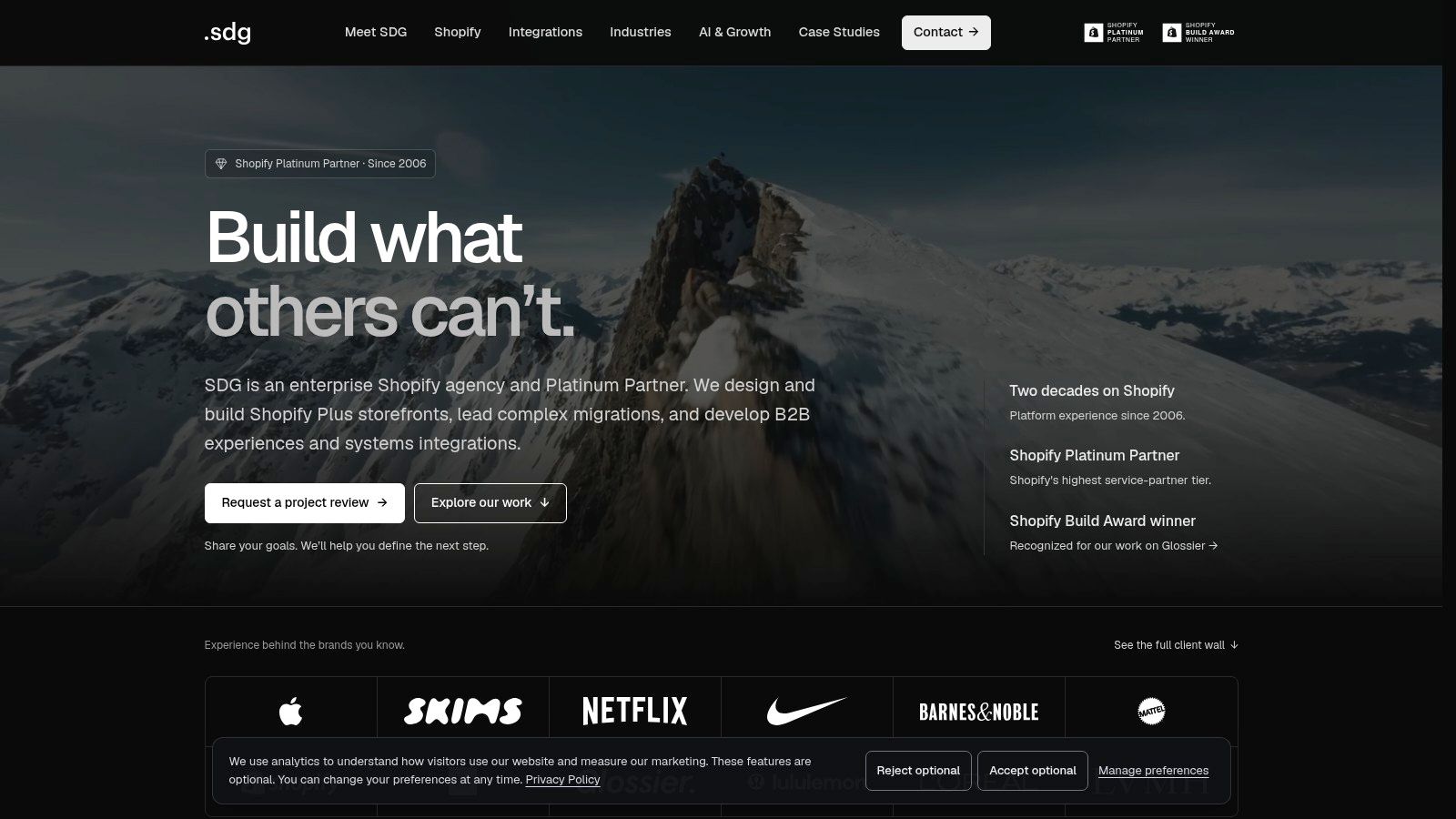
SDG positions itself as an enterprise-focused Shopify agency and Platinum Partner. Its offer covers Shopify Plus builds, complex replatforming, B2B commerce, systems integration, and conversion optimization. Published case studies include Barnes & Noble, Glossier, and Everlane, which gives you named work to inspect before a first call.
That enterprise framing fits Shopify Plus itself. According to Shopify's launch announcement, Shopify Plus was formally launched in February 2014 as Shopify's enterprise-ready commerce offering, and it had already attracted brands including Google, DODOcase, the Los Angeles Lakers, Budweiser, and Tesla Motors. Plus was enterprise from day one. Your partner should treat it that way.
<a id="who-this-model-fits"></a>
Who this model fits
SDG may suit larger brands dealing with complex catalogs, back-office systems, or high-stakes migrations where data, integrations, SEO, and launch planning all carry risk. Its public examples describe project scope and architecture, which helps you judge whether its past complexity matches yours. The agency says it has worked on Shopify since 2006, a claim you can test by asking who on your project carries that experience.
If you're still clarifying what an agency should own versus your internal team, read this overview of what a Shopify agency does across strategy, build, and support before you brief anyone. It'll sharpen your questions on ownership.
Pros: Named enterprise case studies you can review. Services run from migration through ongoing optimization. Long stated history on the platform.
Cons: Enterprise positioning may not suit smaller budgets or simple theme projects. No standard project pricing is publicly listed. Scope and cost require a direct review and proposal, so ask early whether your budget range fits its typical engagement size.
<a id="3-avex"></a>
3. Avex

Avex is a New York-based agency pairing Shopify Plus engineering with UX, conversion optimization, migrations, and international commerce. Published work includes quip, FILA, Vitality, and J. Peterman. Its delivery model fits a platform move bundled with a redesign, international expansion, or a CRO program. If you only need a replatform with your current design intact, you may be paying for capability you won't use.
Checkout work deserves scrutiny in any Avex proposal. The Presidio guide to Shopify Checkout Extensibility notes that Shopify reports its checkout converts up to 36% better than competing platforms and 15.2% better on average in a commissioned study. Don't let any agency promise you that uplift. Ask instead how it'll rebuild your payment, delivery, and discount rules as upgrade-safe UI extensions and Shopify Functions, not fragile client-side scripts copied from your legacy stack.
<a id="questions-to-put-to-avex"></a>
Questions to put to Avex
- Architecture ownership: Who leads technical architecture, and who owns each migration workstream?
- Migration sources: Its listed experience covers Magento, Salesforce Commerce Cloud, BigCommerce, and custom platforms. Ask for the closest match to yours, and ask which side owns data mapping for product records, customer accounts, and order history.
- International scope: Confirm how multi-store setup, B2B or wholesale, and headless commerce would be phased if you need them, and whether phasing them later adds rework.
Pros: US-based team with a Shopify Partner Directory profile. Design and technical implementation under one roof. Public case studies and testimonials address migration, integration, and conversion work.
Cons: Avex doesn't publish standard pricing, so every engagement needs a custom quote scoped to the work. Confirm who owns architecture before you sign, since a design-led pitch can hide unclear engineering accountability.
<a id="4-bounteous"></a>
4. Bounteous
Bounteous is a large North American digital consultancy with Shopify Plus experience across CPG, home and interiors, B2B, beauty, and health. Published case studies include Staples Canada, Chatters, and Gaia Herbs. One published example describes a site with more than 85,000 SKUs, which signals comfort with large catalogs.
That scale suits organizations folding Shopify Plus into a broader digital commerce or technology transformation, not just a storefront rebuild. B2B work is where breadth can help or hurt. In Shopify's B2B commerce coverage, 73% of surveyed organizations reported increased demand for digital B2B sales, but only 20% felt prepared for the future. The barrier usually isn't the portal design. It's fragmented ERP, CRM, and pricing data and customer hierarchies your legacy systems can't model cleanly.
A polished B2B storefront on top of broken account hierarchies and contract pricing is still a broken B2B operation. Test the data before you approve the design.
<a id="what-to-verify"></a>
What to verify
Ask Bounteous to show how it handles account hierarchies, locations, approval workflows, contract pricing, tax rules, and synchronization failure recovery. Ask who owns data quality when the ERP disagrees with the storefront. This guide on how to choose a Shopify development company gives you a framework for scoring those answers against smaller specialists.
Pros: Scale and breadth for complex systems and multiple internal teams. Public omnichannel and large-catalog examples. North American presence and a long-running Shopify partnership.
Cons: A large consultancy model may be more process-heavy than a specialist agency. Shopify is one part of a broader portfolio, so clarify the dedicated team and delivery model. No public project pricing is available.
<a id="5-turnaround"></a>
5. Turnaround
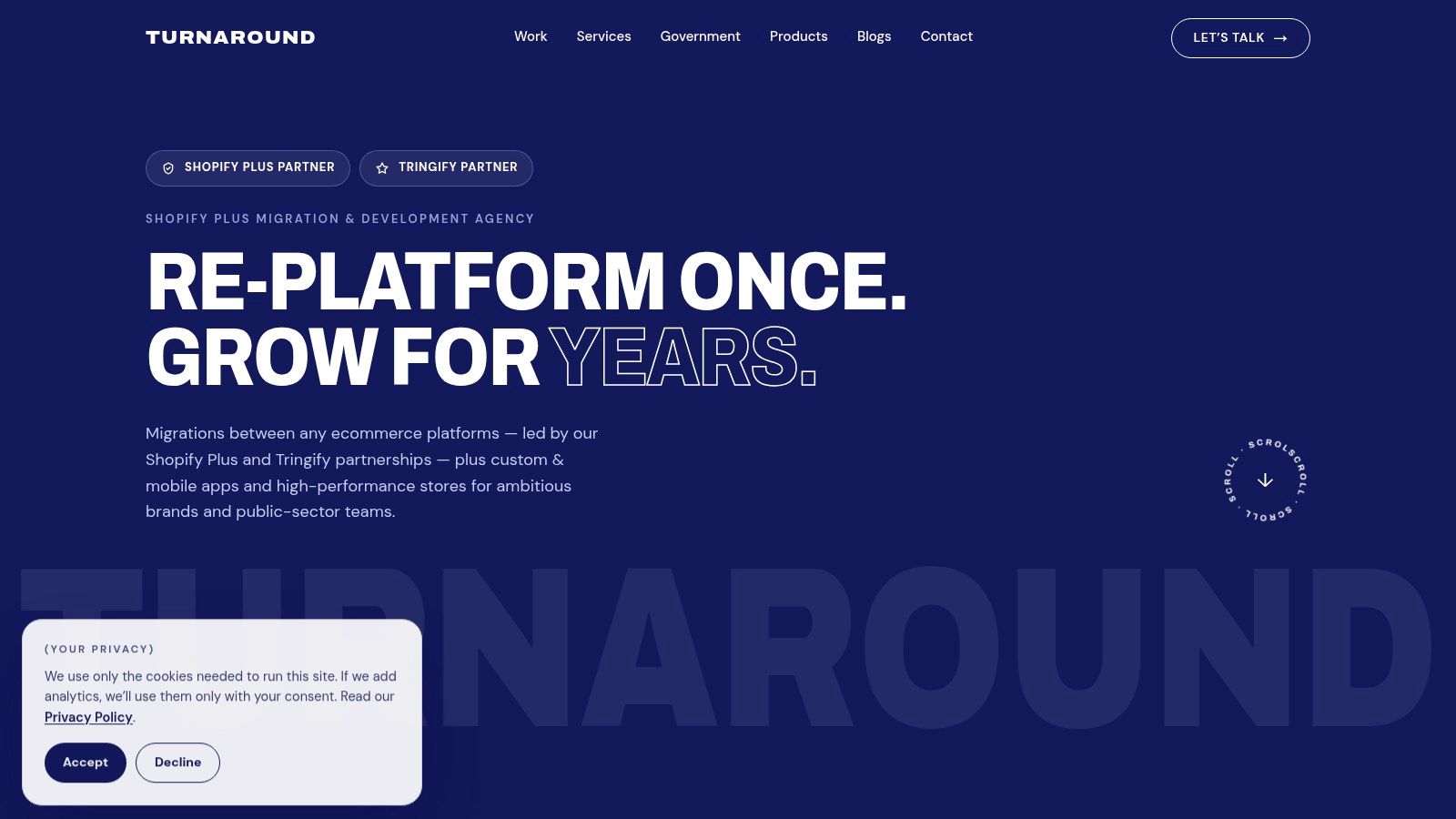
Say your board has approved leaving Adobe Commerce. Your biggest fear isn't the new theme. It's losing three years of organic rankings in six weeks. That scenario is where Turnaround aims its pitch.
Turnaround focuses on replatforming and ongoing development and reports more than 150 Shopify migrations. Services span storefront development, SEO and redirect planning, operational integrations, UX, and custom apps. Listed integration work covers ERP, OMS, PIM, and fulfillment, plus theme and headless storefront development.
<a id="judge-the-post-launch-plan-not-the-launch-date"></a>
Judge the post-launch plan, not the launch date
The Shopify Plus data migration guidance recommends tracking rankings and organic traffic for 60 to 90 days and conducting post-launch crawls for broken links, redirect chains, and missing pages. So ask Turnaround who owns your first 90 days. Ask what thresholds trigger remediation, how crawl errors and failed orders get monitored, and what the dashboard looks like.
- Migration is central: It's the core offer, not an add-on to design work.
- SEO verification: Redirect mapping and migration verification are listed services, so request a sample redirect plan.
- Operational depth: Storefront and back-office systems sit in the same scope.
Pros: Migration-first positioning for merchants leaving Adobe Commerce, BigCommerce, or Salesforce. Listed platform experience covers common replatforming scenarios. Post-launch services include performance and accessibility work.
Cons: Performance and portfolio figures on its website are agency-reported, so validate them with references. Pricing isn't published. Confirm Shopify Plus experience for your specific use case, not just general Shopify work.
<a id="6-simplistic"></a>
6. Simplistic
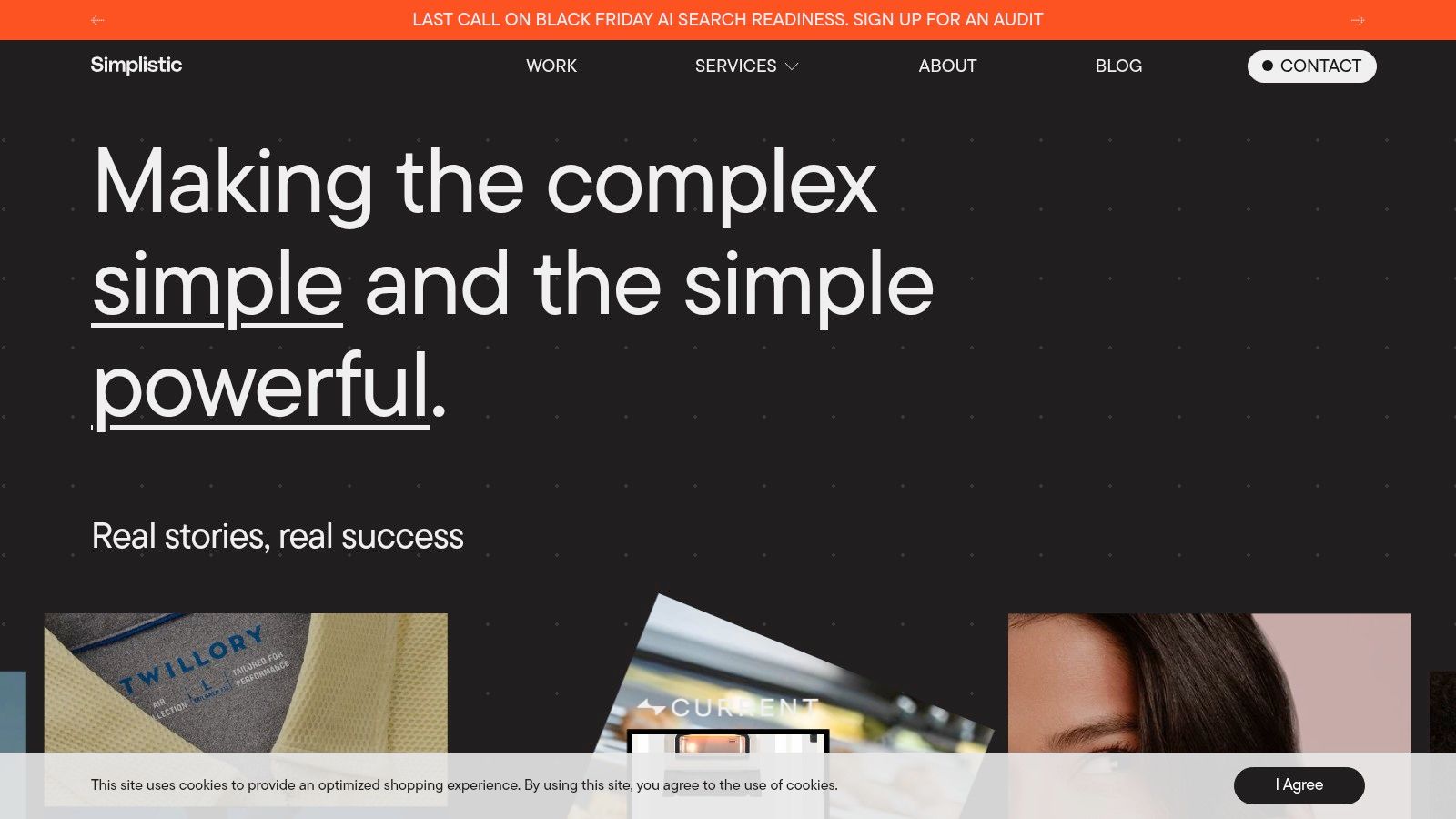
Simplistic is a Shopify Plus Partner offering design and development, migration planning, ERP integration, technical SEO, CRO, analytics, and ongoing site management. It positions services for DTC and B2B or wholesale merchants. If you want implementation and continued optimization from one partner, its model is built for that.
Platform-level satisfaction data is worth reading carefully here. The Digital Applied Shopify statistics summary notes Shopify cites a 2025 Gartner Voice of the Customer result in which 91% of respondents recommended Shopify, based on 47 reviews available in January 2025. That's directional evidence for the platform. It isn't evidence about any single agency, and it doesn't replace your own due diligence on catalog complexity, integration dependencies, and SEO risk.
<a id="how-to-evaluate-the-offer"></a>
How to evaluate the offer
Simplistic combines theme development and technical discovery with data migration planning and execution. It also offers CRO, A/B testing, analytics, and outsourced development support. That breadth is useful if your internal team is thin. It's a risk if responsibilities blur.
What I'd ask first: Which parts of migration, ERP integration, and technical SEO does your own team perform, and which parts do partners or contractors perform?
Pros: Services extend beyond launch into optimization and support. Technical implementation sits alongside CRO capabilities. The agency publishes information about its Shopify Plus Partner history and site launches.
Cons: Published site claims are self-reported and should be validated. No public pricing is listed. Confirm migration scope and experience with systems comparable to yours before shortlisting.
<a id="7-softlimit"></a>
7. Softlimit
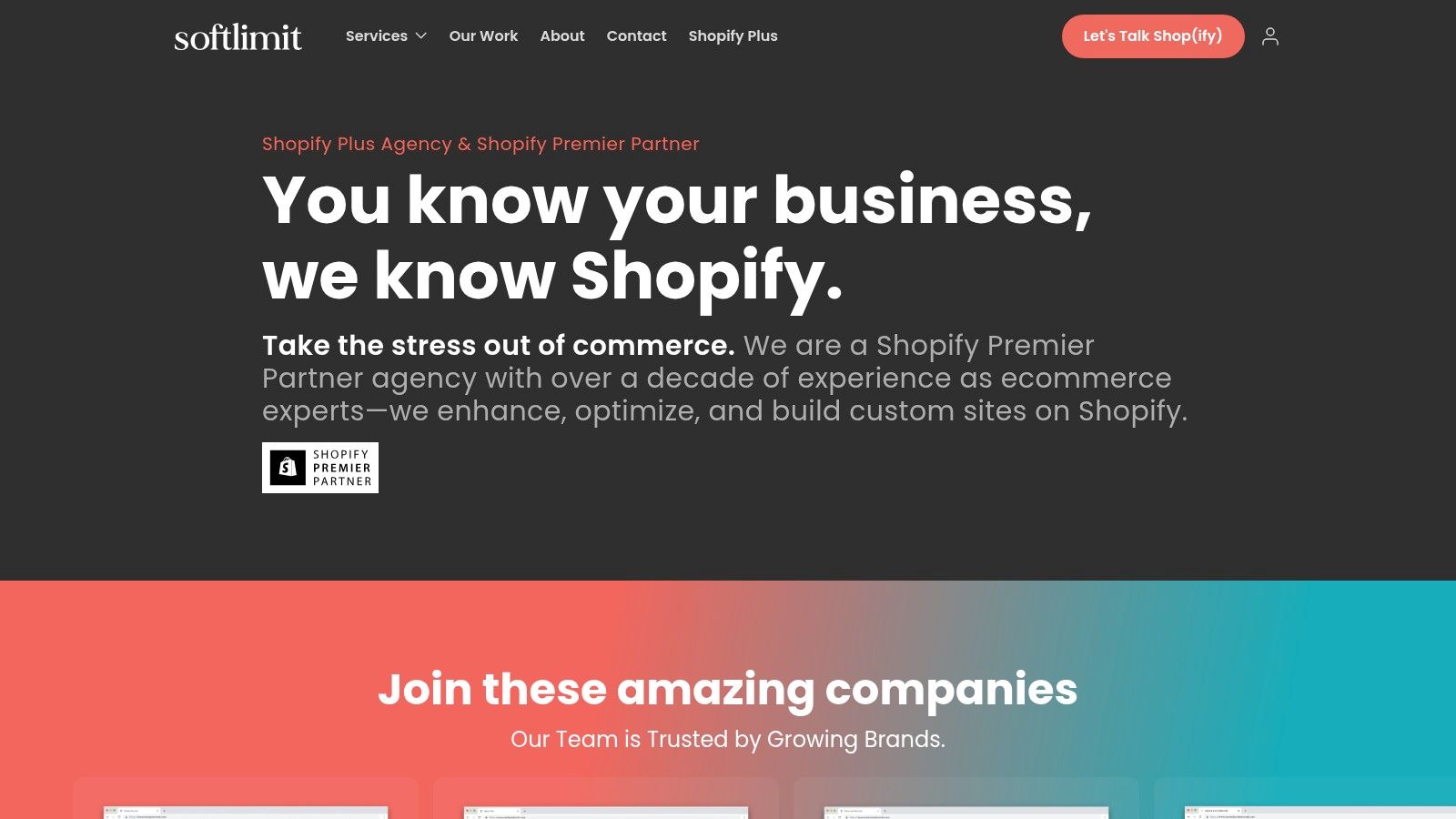
Softlimit is a Shopify Premier Partner offering custom Shopify builds, optimization, integrations, audits, and migration services, including Shopify Plus support. Published work covers custom design and theme builds, ongoing optimization, and B2B migration. It may suit brands that want a hands-on development partner with continuing support baked in.
Payment behavior should shape your early conversations with any partner, including Softlimit. According to the Shopify FY2025 annual report notice, Shopify Payments processed 65.6% of Shopify's GMV in 2025. If you're moving payment flows, subscriptions, or saved payment methods, ask exactly how your authorization rates and accelerated checkout setup will be tested before launch.
<a id="strengths-and-limits"></a>
Strengths and limits
Softlimit publishes client feedback describing collaboration and responsiveness, and ongoing support is part of its service mix rather than a paid extra. It highlights integrations with tools including Recharge, Rebuy, and Gorgias, which tells you it's comfortable inside a typical DTC app stack. Its offer also includes website audits, a low-commitment way to test the working relationship.
- Best fit: Brands wanting custom builds plus continuing optimization from a smaller, responsive team.
- Watch out for: Less public detail on large enterprise migrations than some alternatives here.
- Confirm first: Experience with your specific ERP or PIM stack, catalog size, and legacy platform.
Pros: Published client feedback on responsiveness. Ongoing support is core to the offer. Named app integration experience with common DTC tools.
Cons: No public pricing is listed. Enterprise migration depth is less documented publicly, so request comparable project detail during discovery.
<a id="how-the-seven-shopify-plus-agencies-differ-on-best-fit-migration-focus-and-pricing-disclosure"></a>
How the seven Shopify Plus agencies differ on best fit, migration focus, and pricing disclosure
Use this table to cut the list to two or three candidates, then test each one against the scoping questions in the profiles above.
| Item | Best fit | Migration focus | Public pricing |
|---|---|---|---|
| United Victory Technologies | Established brands needing Shopify or Shopify Plus migration and ongoing growth support | Data, SEO redirects, integrations, international commerce, and storefront rebuilds | Not published; request an assessment |
| SDG | Enterprise brands with complex commerce systems or B2B needs | Complex replatforming, data, integrations, SEO, and launch planning | Not published; proposal required |
| Avex | Brands pairing migration with UX, CRO, or international expansion | Migrations from Magento, Salesforce Commerce Cloud, BigCommerce, and custom platforms | Not published; custom quote required |
| Bounteous | Organizations undertaking complex digital commerce or technology transformation | Enterprise Shopify Plus implementations, including large catalogs and B2B or DTC | Not published |
| Turnaround | Merchants seeking a migration-focused Shopify agency and operational integrations | Migration planning, SEO redirects, ERP, OMS, PIM, and fulfillment integrations | Not published |
| Simplistic | DTC or B2B brands seeking implementation and ongoing optimization | Data migration planning and execution, ERP integration, and technical SEO | Not published |
| Softlimit | Brands seeking hands-on Shopify development and continuing support | Shopify migrations, Shopify Plus support, and app integrations | Not published |
<a id="turning-a-shortlist-into-a-signed-partner"></a>
Turning a Shortlist Into a Signed Partner
Every Shopify Plus web development company on this list can build you a storefront. That isn't the decision. The decision is who protects your revenue, data, and search visibility while your platform changes underneath them.
Before you request proposals, send each shortlisted agency the same three questions. Who will own the technical architecture? Name the person, not the department. How will redirects and SEO continuity be verified at launch? Ask for the crawl plan, the redirect reconciliation process, and the monitoring window. How will ERP, PIM, or OMS integrations be tested? Ask about staging data, failure recovery, and who signs off when sync breaks. Compare the written answers, not the homepage claims.
<a id="score-the-answers-you-get-back"></a>
Score the answers you get back
- Specific beats confident: A named architect, a test dataset, and a rollback threshold beat any promise of a smooth launch.
- Scope beats timeline: The fastest migration quote usually excludes the post-launch stabilization work that protects rankings and orders.
- References beat logos: Named case studies help, but a conversation with a comparable merchant helps more. Where work is anonymized, ask what verification is possible under NDA.
Also quantify your own position before calls start. Document your catalog size, integration list, B2B pricing rules, international storefronts, and current platform costs. Agencies can't scope what you haven't inventoried, and vague briefs produce vague proposals. For enterprise brands with complex back-office needs, we offer the option to talk to a Shopify Expert before you commit to a scope, and our Migration Assessment covers your current stack in detail.
My recommendation is simple. Shortlist three firms from this list based on delivery model fit. Send all three the same written questions. Sign with the one whose answers name owners, tests, and thresholds. That's the partner most likely to still be useful on day 90, when the launch-day excitement is gone and the numbers need defending.
If you're planning a move to Shopify Plus and want the migration scoped around your data, integrations, and SEO before anyone touches a theme, start with a migration assessment or store audit from our team. We handle structured replatforming, checkout extensibility, B2B, and post-launch CRO as one engagement, so visit United Victory Technologies to tell us what platform you're leaving and what can't break along the way.