
7 Best Shopify Plus Developers for Complex Migrations
Compare the 7 best Shopify Plus developers for migrations, B2B, integrations, and ongoing support. Find the right partner for your enterprise store.
Hiring the agency with the strongest portfolio is popular advice. For a complex migration, it's the wrong starting point. The right Shopify Plus partner matters more than the logo, because attractive storefronts don't demonstrate how a team reconciles historical orders, preserves redirects, or handles an unavailable ERP.
A Shopify Plus developer can look equally credible in a polished presentation while differing substantially in migration methodology, integration depth, B2B expertise, and post-launch support. Your shortlist should reflect the work your business needs: catalog-heavy operations, wholesale pricing, international commerce, or a design-led DTC rebuild.
Shopify's enterprise platform overview positions Plus around high-volume commerce and complex operations. Treat the implementation accordingly. You're buying a new operating model for commerce, not merely a replacement theme.
Shortlist agencies by the hardest operational requirement they must solve, then evaluate design quality within that shortlist.
The agencies below suit different buyer scenarios. United Victory Technologies warrants attention for migration-led engagements, Uncap for ERP-centered B2B, and Presidio for design-led storefront work. The deciding evidence should be a project-specific architecture, clear commercial responsibilities, and a credible plan for operating the store after launch.
Table of Contents
- 1. United Victory Technologies
- 2. Total Commerce
- 3. Uncap
- 4. Ecommerce Pro
- 5. Magebit
- 6. Presidio
- 7. BLACKBELT COMMERCE
- Top 7 Shopify Plus Developers Compared
- Shortlist by Fit, Then Validate the Migration Plan
<a id="1-united-victory-technologies"></a>
1. United Victory Technologies
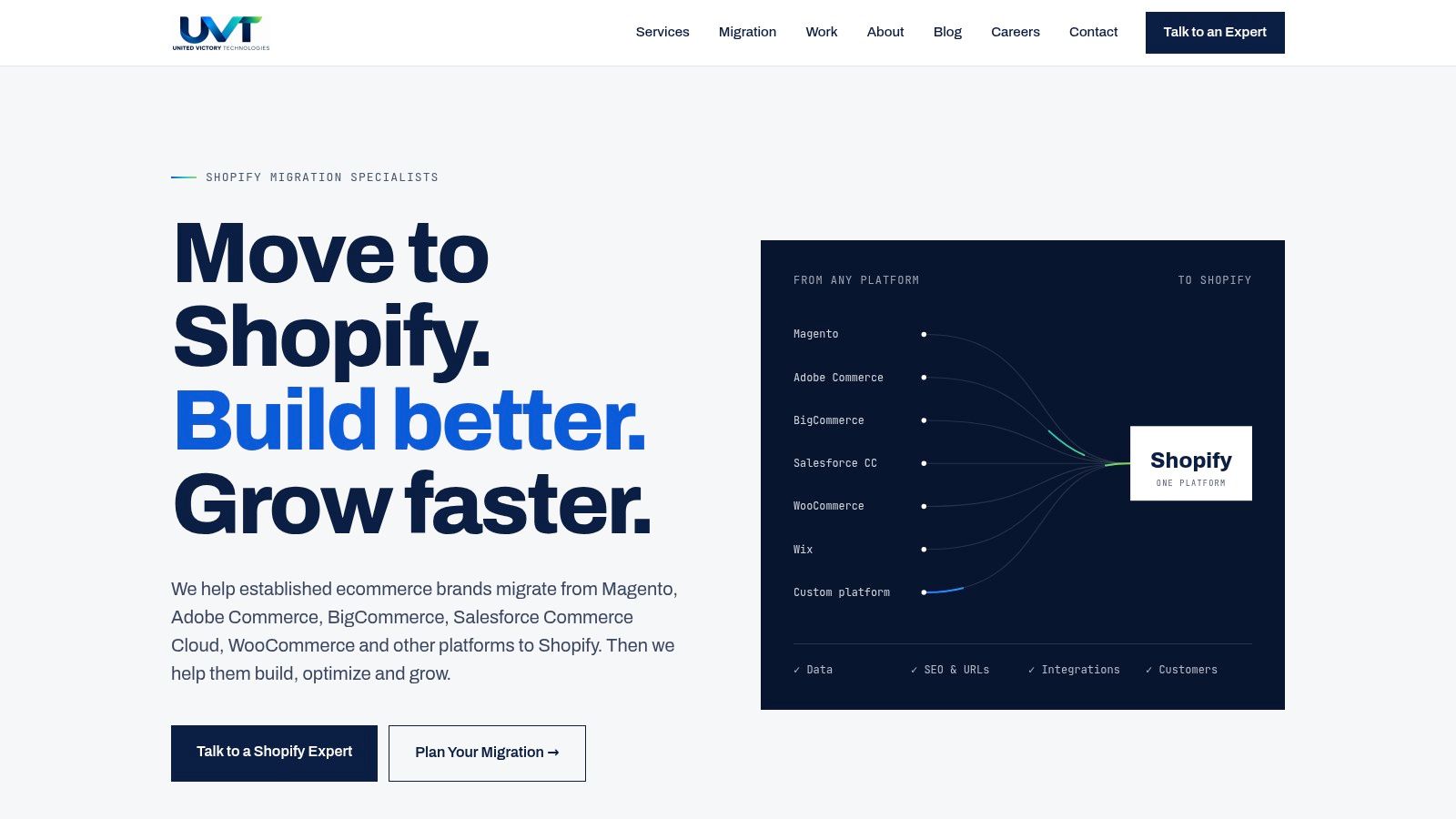
Best fit for established brands that need migration, integration, and ongoing optimization under the same engagement. United Victory Technologies specializes in moving merchants from Magento, Adobe Commerce, BigCommerce, Salesforce Commerce Cloud, WooCommerce, site builders, and custom platforms to Shopify or Shopify Plus.
Its migration scope addresses products, customers, historical orders, content, SEO URLs, redirects, and business integrations. The important distinction is its emphasis on rebuilding the storefront for Shopify's section-based themes rather than copying legacy templates. That's the right approach when the existing store contains years of platform-specific compromises.
The agency identifies as a Shopify Select Partner and offers Shopify Plus architecture, B2B capabilities, international commerce, and ERP/PIM/CRM/OMS integrations. Its comparison of Shopify Plus agencies provides additional context for buyers assessing different partner models.
<a id="validate-the-migration-and-support-model"></a>
Validate the Migration and Support Model
United Victory Technologies also offers ongoing development and evidence-led conversion optimization across navigation, product pages, checkout, mobile performance, and analytics. That combination suits merchants who want the implementation team to remain accountable after the migration, rather than handing the store to an unfamiliar support vendor.
Its confidentiality-first model requires a different diligence process. Engagements operate under NDA, and anonymized case studies limit public client identities and independently attributable references.
- Migration evidence: Request a redacted data-mapping document, redirect specification, reconciliation report, and launch acceptance criteria.
- Integration depth: Ask the proposed technical lead to explain inventory ownership, failed-event recovery, and how duplicate order creation is prevented.
- Commercial clarity: Obtain a scoped proposal separating discovery, migration, integrations, app subscriptions, launch coverage, and ongoing development.
The strength is continuity across migration and growth. The trade-off is reduced public visibility into client work. Don't substitute anonymized outcomes for technical validation. Ask the team to walk through a comparable architecture and demonstrate how it would handle your highest-risk workflow.
Choose this agency when protecting data, SEO equity, customer experience, and connected systems matters as much as the storefront redesign. Make the post-launch operating model part of the initial agreement.
<a id="2-total-commerce"></a>
2. Total Commerce
A migration isn't complete when the catalog appears in Shopify. Finance still needs reliable tax and payment records, marketing needs usable analytics, and operations needs subscriptions and fulfillment workflows to behave correctly.
Total Commerce is a strong shortlist candidate for buyers who want those operational requirements included alongside storefront development. The New York-based agency focuses on Shopify Plus, complex replatforming, B2B, ERP/PIM integrations, and international commerce.
Its stated migration scope includes data structures, subscriptions, redirects, SEO, analytics, tax, payments, quality assurance, and launch support. That breadth suits mid-market merchants whose migration involves several internal departments rather than an ecommerce team working alone.
<a id="buy-a-defined-launch-scope"></a>
Buy a Defined Launch Scope
Ask Total Commerce to turn its broad service coverage into named deliverables and accountable owners. Subscription migration, for example, shouldn't sit inside a general data-transfer line item without an explanation of payment dependencies, customer communication, and acceptance testing.
- Confirm system experience: Request comparable work involving your ERP, PIM, subscription provider, and target markets.
- Separate estimates: Distinguish storefront development from data remediation, middleware, app configuration, and launch support.
- Test business transactions: Include refunds, tax treatment, subscription renewals, and cross-border purchases in acceptance testing.
Shortlist Total Commerce for operationally complex replatforming, not a lightweight theme refresh. Its service mix is relevant when integrations and international requirements are central to the business case.
For merchants entering the US market, ask how the team will validate payments, regional merchandising, shipping, and analytics together. The commercial question is whether those responsibilities are included in the proposed scope or left for your internal team to coordinate.
<a id="3-uncap"></a>
3. Uncap
Start with Uncap when your ERP and wholesale operating model determine the storefront requirements. Manufacturers, distributors, and wholesalers need more than attractive category pages. Buyers must see the correct products, account-specific pricing, inventory, and purchasing permissions.
Uncap concentrates on Shopify B2B, unified commerce, migrations, and ERP integration. Its published capabilities include systems such as NetSuite, Microsoft Dynamics, Acumatica, Epicor, Infor, and Sage, alongside custom applications and ongoing store management.
That focus makes it a more relevant starting point for ERP-centered commerce than an agency whose strongest work is primarily brand presentation. It doesn't remove the need to verify experience with your exact ERP configuration, custom fields, and integration middleware.
Practical rule: Don't accept “we integrate with your ERP” as an architecture. Ask which system owns each field and what happens when synchronization fails.
For this type of project, require an ownership matrix covering customer accounts, company permissions, negotiated pricing, inventory, orders, and fulfillment. Shopify's ERP integration guidance identifies manual re-entry and inconsistent records as operational risks. Your agency should explain how its design avoids both.
<a id="test-the-buyers-real-workflow"></a>
Test the Buyer's Real Workflow
Use a realistic purchasing scenario during discovery: an approved company buyer orders against negotiated pricing, changes delivery details, and receives a partial fulfillment. Ask Uncap to identify the Shopify configuration, ERP rules, custom logic, and exception handling involved.
The publisher's guide to choosing a Shopify development company provides a broader framework for evaluating delivery capability.
Choose Uncap for B2B operational depth. For a purely design-led DTC rebuild, compare its proposed creative team and process directly against storefront-focused alternatives before committing.
<a id="4-ecommerce-pro"></a>
4. Ecommerce Pro
Ecommerce Pro belongs on the shortlist when you want a single agency to handle migration, redesign, theme customization, and ongoing website management. Its services span Shopify and Shopify Plus, including migrations from platforms such as Magento, BigCommerce, and WooCommerce.
That breadth is useful for merchants whose current store needs both technical replacement and clearer merchandising. A catalog migration and a navigation redesign should inform each other, rather than proceed as disconnected workstreams.
Its B2B offering includes wholesale access, tiered pricing, and minimum order quantities. Evaluate those capabilities against your actual purchasing rules instead of treating a wholesale service label as proof of enterprise B2B suitability.
<a id="define-what-full-service-includes"></a>
Define What Full Service Includes
The main buying risk is an ambiguous boundary between migration, design, integration, and support. A broad agency relationship only reduces handoffs if the contract assigns ownership clearly.
- Data boundaries: Specify which historical orders, customer records, product relationships, and content assets will transfer.
- SEO responsibility: Require redirect mapping, metadata handling, launch validation, and ownership of post-launch corrections.
- Support continuity: Confirm whether the implementation team remains involved and how urgent incidents enter the support queue.
For a clearer distinction between these responsibilities, review what a Shopify agency does before comparing proposals.
Choose Ecommerce Pro for a combined migration-and-storefront engagement. Require a technical workshop before signing if ERP, subscription, or company-account workflows are business-critical.
Ask the agency to demonstrate a specialty-product catalog comparable to yours, including filtering, variant selection, and mobile product discovery. Then connect those storefront decisions to the source product data, so your team knows how merchandising will work after handover.
<a id="5-magebit"></a>
5. Magebit
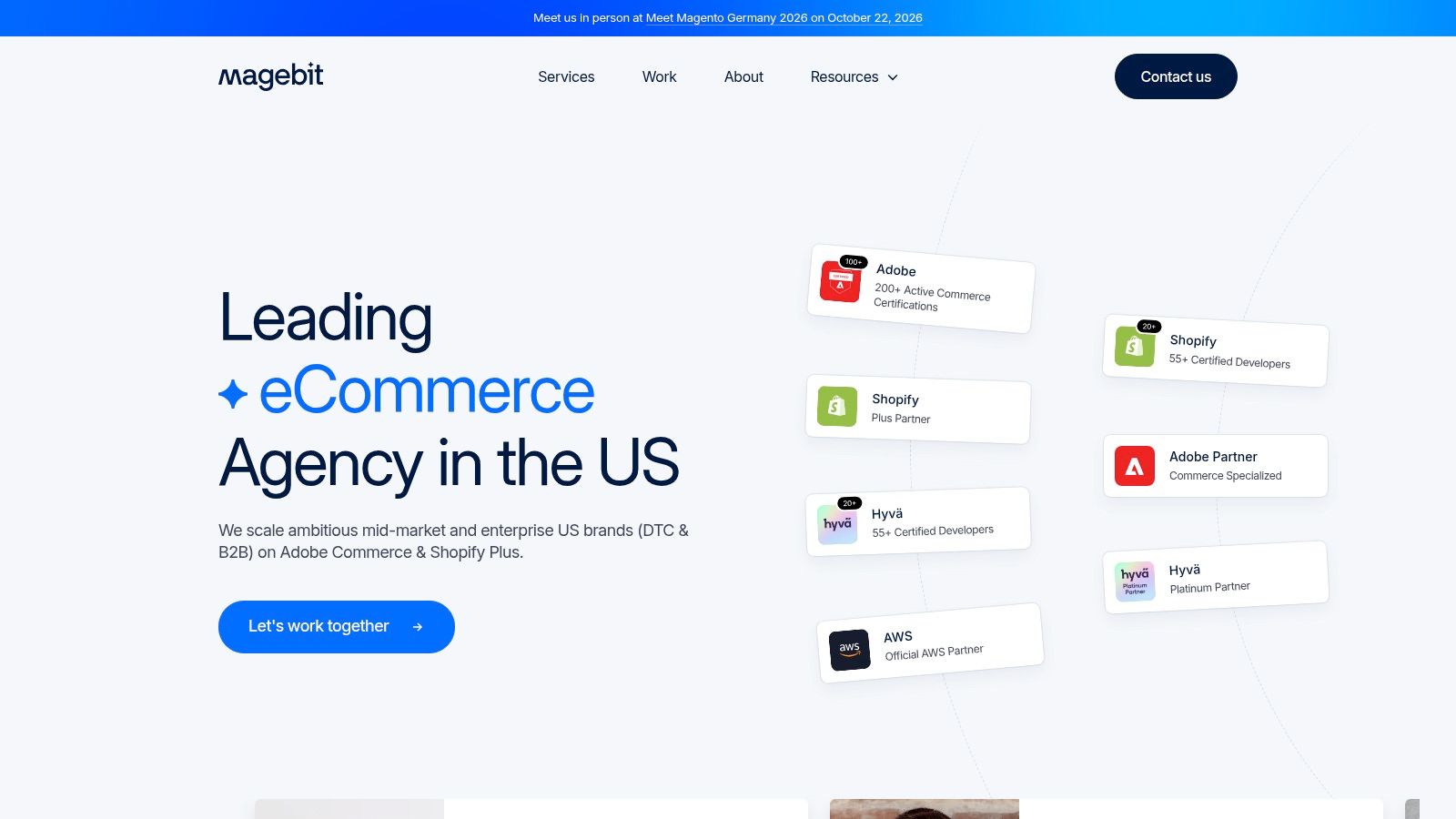
Magebit is worth evaluating when the difficult question is what to retain, replace, or rebuild from Adobe Commerce. Cross-platform experience is especially relevant when your legacy store contains custom pricing, complex product data, or operational logic that nobody wants to lose.
Magebit's US service offering covers Adobe Commerce and Shopify Plus, with integration capabilities spanning ERP, PIM, CRM, WMS, OMS, and POS. It also offers Shopify B2B development, dedicated developers, support, and performance optimization.
Use that breadth to interrogate the migration strategy. Ask the team to distinguish business requirements from legacy implementation choices, then explain which requirements belong in native Shopify capabilities, applications, middleware, or custom development.
<a id="require-a-checkout-feasibility-assessment"></a>
Require a Checkout Feasibility Assessment
Don't approve a design that assumes the existing checkout can be reproduced unchanged. The checkout extensibility constraints described by Ecosire illustrate why Shopify Plus is a governed checkout environment, not unrestricted access to checkout code.
Extensions can't freely manipulate the checkout DOM or place custom interfaces around sensitive payment-card fields. Payment Customization Functions can control existing payment methods, but they can't introduce a completely new payment method.
Ask the agency to classify every legacy checkout requirement as supported configuration, extension, Function, gateway capability, app integration, or unsupported behavior.
Magebit's stated US-hour availability deserves operational verification, particularly because its headquarters are outside the US. Confirm who attends discovery, who approves releases, and who responds to production incidents.
Choose Magebit for technically demanding cross-platform evaluation. Negotiate a discovery deliverable that documents architectural decisions, rejected alternatives, recurring software costs, and the internal skills you'll need after launch.
<a id="6-presidio"></a>
6. Presidio
A design-led DTC migration needs a different partner profile from an ERP-led wholesale program. Presidio is a strong candidate when brand presentation, merchandising, theme development, and ongoing conversion work drive the brief.
Presidio focuses on Shopify design, development, migrations, and optimization. Its public work includes brands such as OUAI, Momofuku, Equator Coffees, and Bobbie, making it relevant to buyers who want to examine visible storefront execution.
Evaluate that work beyond its visual polish. Product discovery, subscription selection, filtering, and the relationship between online and retail experiences should match the way your customers shop.
<a id="look-behind-the-storefront"></a>
Look Behind the Storefront
Ask the proposed team to demonstrate how merchants edit the finished store. A custom theme should give your ecommerce team useful control over sections, content, and merchandising without requiring a developer for every campaign change.
- Subscription behavior: Test purchase options, discounts, customer-account journeys, and the responsibilities of the subscription application.
- Merchandising flexibility: Inspect product templates, filtering, collection layouts, and reusable campaign sections.
- Growth ownership: Define who maintains the analytics baseline, proposes experiments, and implements validated improvements.
Choose Presidio for a design-led rebuild with ongoing development needs. If the project depends on complex ERP synchronization or negotiated B2B pricing, require comparable operational evidence before treating it as an equally strong fit.
Don't use the price of an isolated service as a benchmark for a full Shopify Plus migration. Request a project-specific proposal that distinguishes creative work, theme engineering, integrations, migration, and post-launch optimization.
The strongest commercial arrangement will also specify who owns the theme repository, design files, application accounts, and documentation. Your team should retain the assets and access needed to continue operating the store independently.
<a id="7-blackbelt-commerce"></a>
7. BLACKBELT COMMERCE
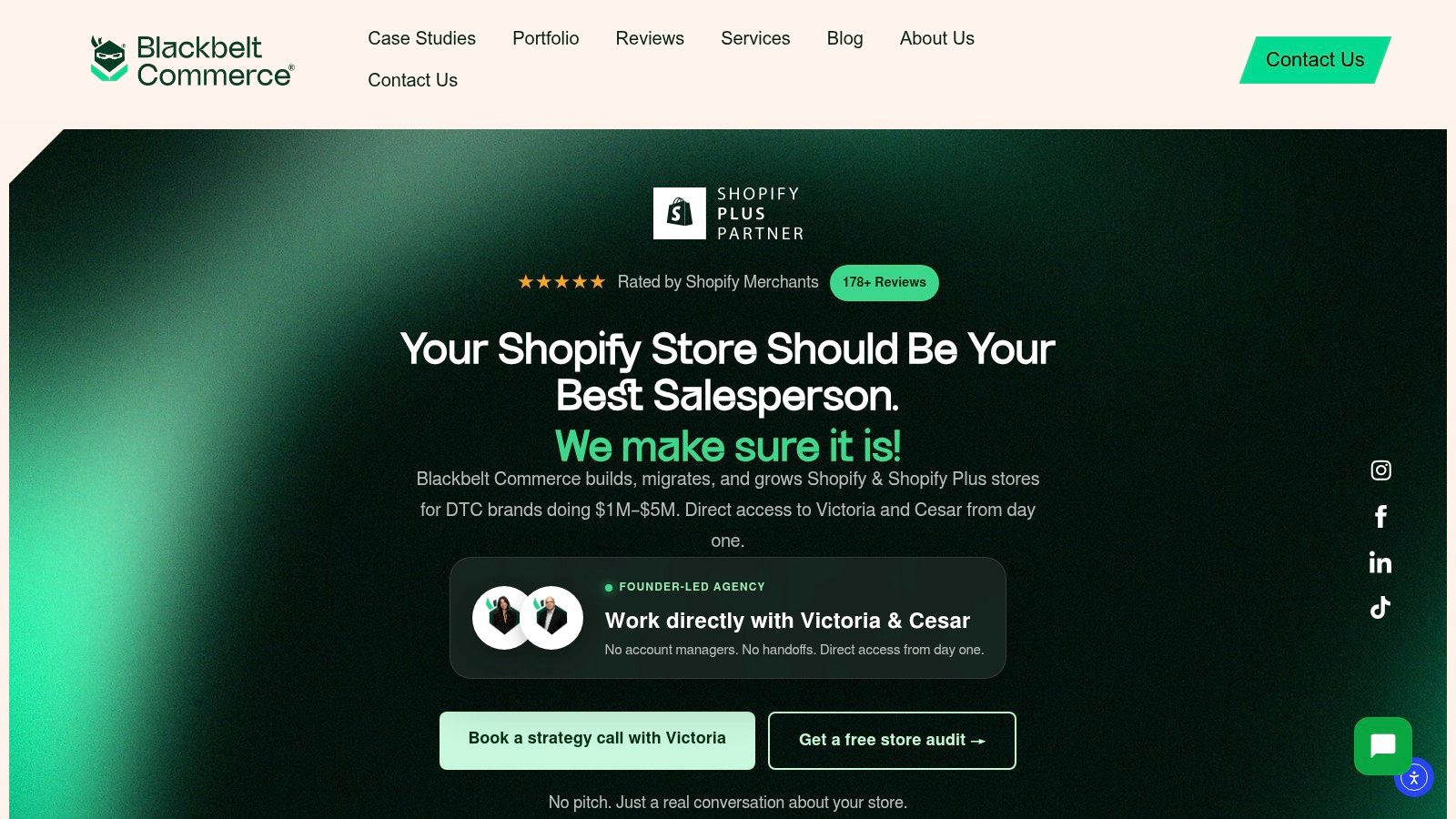
For merchants who want development, SEO, and conversion work in the same relationship, BLACKBELT COMMERCE deserves consideration. Its offering includes Shopify Plus builds, migrations, B2B, custom integrations, ongoing management, and growth services.
Its published migration scope addresses products, customers, orders, content, SEO, and redirects. The agency also describes custom applications and wholesale workflows, making it relevant to businesses that need more than a storefront refresh.
The buying advantage is a connected implementation-and-growth brief. The diligence requirement is proof that integration engineering receives the same attention as design, SEO, and conversion optimization.
<a id="make-reliability-part-of-acceptance"></a>
Make Reliability Part of Acceptance
For API-heavy migrations, ask how the agency batches jobs, checkpoints progress, retries failures, and prevents duplicate writes. Shopify's API limits documentation explains that requests exceeding the applicable allowance can return HTTP 429 errors, so an unrestricted import script isn't a sufficient migration plan.
Require a demonstration of failed-job recovery using representative data. The team should explain how operators identify an exception, correct its cause, replay the job, and reconcile the result.
- Comparable evidence: Request a migration using a similar source platform and integration stack.
- B2B acceptance: Test company accounts, catalog visibility, custom pricing, and wholesale purchasing permissions.
- Growth accountability: Separate migration defects from optimization requests in the support agreement.
Choose BLACKBELT COMMERCE when you want a continuing development relationship connected to organic acquisition and conversion work. Before signing, agree on how launch performance will be assessed and which analytics changes could affect comparisons.
Don't accept a general promise to monitor the store. Specify incident ownership, escalation contacts, integration alerts, and the process for approving and releasing fixes.
<a id="top-7-shopify-plus-developers-compared"></a>
Top 7 Shopify Plus Developers Compared
| Agency | 🔄 Implementation complexity | ⚡ Resource requirements / pricing | 📊 Expected outcomes | ⭐ Ideal use cases | 💡 Key advantages |
|---|---|---|---|---|---|
| United Victory Technologies | High; end-to-end migrations, integrations, SEO, and custom development | Project-specific quote; pricing not published | Case studies report 98% organic traffic retained and conversion gains up to 34% | Established brands moving to Shopify or Shopify Plus | Broad platform experience, post-launch CRO, and confidentiality-first engagement |
| Total Commerce | High; complex replatforming, integrations, and international commerce | Migrations from $20,000; builds/redesigns from $18,000 | Migration scope includes SEO, analytics, QA, and launch support | Mid-market and larger merchants with complex systems | Published starting prices; 5.0 rating from 46 directory reviews |
| Uncap | High; ERP, B2B, and complex catalog implementations | Pricing not published | Examples include a B2B store with over 1 million SKUs and ERP/PIM integration | Manufacturers, distributors, and wholesalers | Broad ERP expertise and demonstrated complex product-data work |
| Ecommerce Pro | Medium to high; migrations, builds, redesigns, and B2B features | Quote-based; pricing not published | More than 500 completed projects reported; 5.0 rating from 133 directory reviews | Merchants seeking migration, design, and ongoing support | Broad service mix and substantial directory review history |
| Magebit | High; enterprise integrations and cross-platform development | Pricing not published | Supports Shopify Plus development, integrations, and speed optimization | Mid-market and enterprise brands with demanding technical needs | Adobe Commerce and Shopify Plus experience; broad integration capabilities |
| Presidio | Medium to high; custom themes, migrations, and integrations | Project-specific quote; directory starting figure applies to selected services | More than 900 Shopify stores supported; 5.0 rating from 100 directory reviews | DTC brands seeking storefront design and ongoing optimization | Strong public portfolio and conversion-optimization capabilities |
| BLACKBELT COMMERCE | Medium to high; migrations, custom apps, B2B, and integrations | Directory range of $600–$2,500 applies to selected services; full-project pricing requires a quote | 5.0 rating from 178 directory reviews; services include CRO and SEO | Shopify Plus brands needing development plus growth support | Combines migration, custom development, B2B, CRO, and SEO |
<a id="shortlist-by-fit-then-validate-the-migration-plan"></a>
Shortlist by Fit, Then Validate the Migration Plan
Choose the agency whose demonstrated capabilities match your catalog, operating model, integrations, and growth goals. A polished portfolio earns a conversation. A credible migration plan earns the contract.
Start with the hardest requirement. For migration continuity and embedded support, evaluate United Victory Technologies. For operational replatforming, consider Total Commerce; for ERP-centered wholesale, start with Uncap; for a combined store rebuild and management engagement, evaluate Ecommerce Pro. Compare Magebit for cross-platform technical decisions, Presidio for design-led DTC, and BLACKBELT COMMERCE for development connected to SEO and conversion work.
Then request a project-specific scope. It should define data mapping, redirect logic, checkout feasibility, B2B requirements, integration testing, launch rollback, ownership transfer, and post-launch support. Require named owners and acceptance evidence, not a list of services.
Before signing: Have the proposed delivery team walk through a failed order synchronization, an incorrect negotiated price, and a launch rollback. Evaluate their decisions, not just their presentation.
<a id="pay-for-discovery-that-produces-decisions"></a>
Pay for Discovery That Produces Decisions
A paid discovery phase should leave your business with usable architecture and delivery documents. Require a cross-system ownership matrix, migration field mappings, checkout requirement classifications, integration failure procedures, and a release plan.
Technical interviews should include the people who'll build and support the store. References should address communication during difficult releases, responsiveness after launch, and whether the agency completed operational documentation.
Shopify's enterprise checkout guidance supports evaluating extensibility and reliability together. Your acceptance testing should therefore include external-system latency, inventory contention, market-specific rules, and failures in third-party dependencies, not just successful purchases.
Finally, compare total operating responsibility, not only implementation fees. Establish who owns code, middleware, app accounts, monitoring, reconciliation, documentation, and incident response. Separate recurring software costs from development retainers, and define which changes require additional scope.
The best Shopify Plus developer for your business is the partner who can explain how your commercial records stay consistent, how your team operates the store, and how failures get resolved after launch.
United Victory Technologies offers structured Shopify and Shopify Plus migrations, business-system integrations, storefront development, and ongoing optimization for established ecommerce brands. Visit United Victory Technologies to request a migration readiness assessment and discuss your catalog, SEO, B2B, and integration requirements before defining the project scope.