
WooCommerce to Shopify Migration Services: 7 Top Agencies
Compare seven WooCommerce to Shopify migration services by scope, pricing, integrations, and fit for mid-market stores before you choose a partner.
You're staring at a WooCommerce store that's grown into a knot of custom plugins, brittle redirects, and historical orders you can't afford to misplace. That's exactly where woocommerce to shopify migration services stop being a simple vendor search and become a risk review. Agencies differ sharply on what they migrate, how they map WooCommerce logic to Shopify, and whether they publish a price or force you into a quote conversation. The seven providers below are compared on documented migration scope, disclosed pricing, integration depth, and the trade-offs each one carries.
Table of Contents
- 1. United Victory Technologies
- 2. Avex
- 3. BlueSwitch
- 4. Absolute Web
- 5. WPP Enterprise Solutions | Diff
- 6. Corra
- 7. Ziffity
- Top 7 WooCommerce to Shopify Migration Services Compared
- Shortlist Two Partners and Request Scoped Quotes
<a id="1-united-victory-technologies"></a>
1. United Victory Technologies
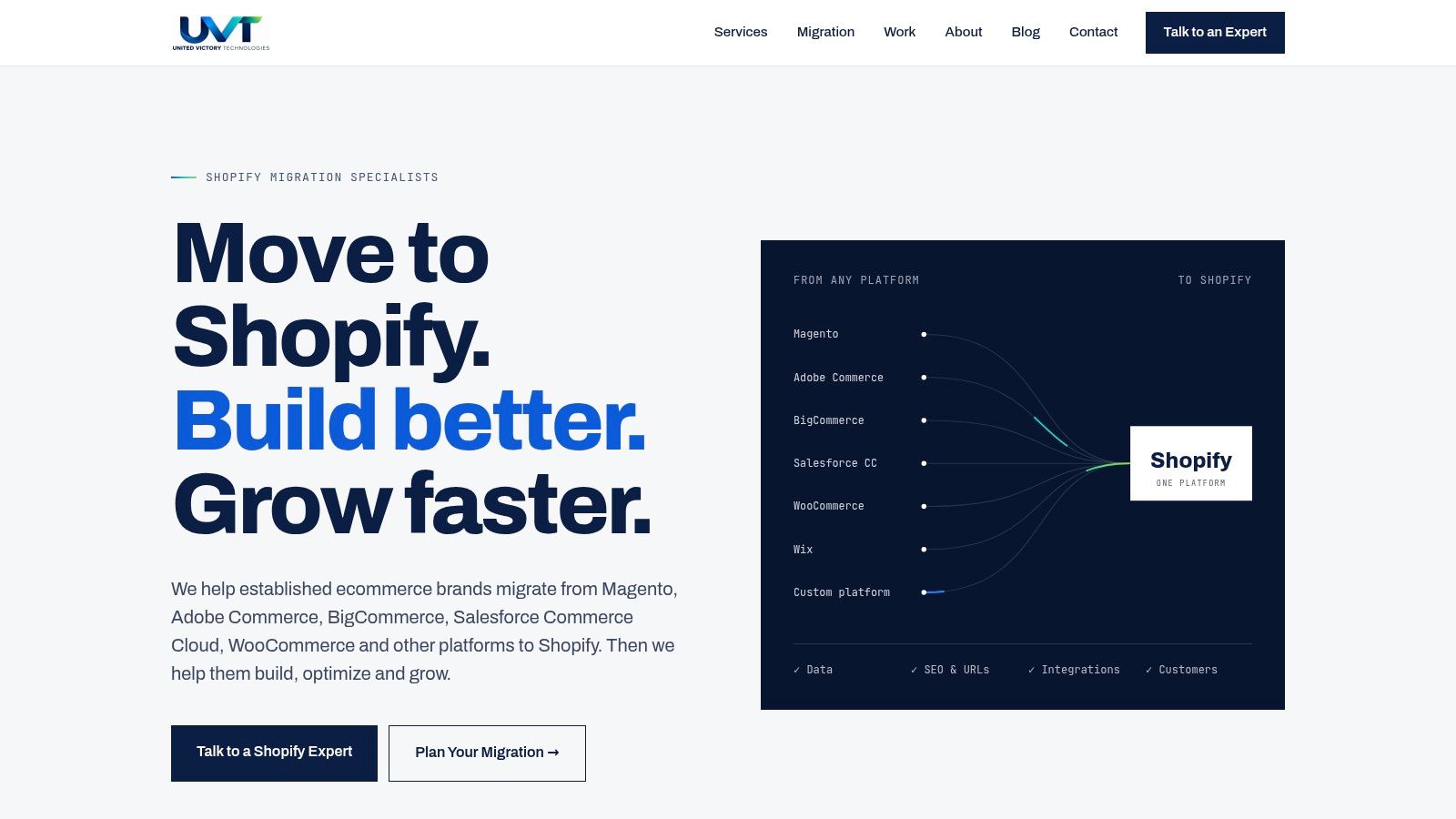
United Victory Technologies documents a migration scope that reaches beyond catalog export. Its published coverage includes products, customers, orders, content, SEO URLs and redirects, and business-critical integrations, which fits the operational demands of moving off WooCommerce. The agency also describes the work as a rebuild for Shopify's section-based themes, a storefront rebuilt for Shopify's structure rather than a copy of the legacy layout.
<a id="what-the-site-documents-and-what-it-doesnt"></a>
What the site documents and what it doesn't
The clearest point of differentiation is integration depth. UVT says it supports Shopify Plus architecture, ERP, CRM, PIM, and OMS integrations, international commerce, and evidence-based conversion optimization. For a WooCommerce migration, that matters because plugin behavior, customer-account rules, and connected systems often shape the cutover as much as the storefront does.
Practical rule: if the old store depends on plugin logic, the migration brief should name the replacement for each behavior, not only the replacement for each record.
UVT also publishes anonymized results from three projects under NDA on its case-study and results material. Those public outcomes include a Magento-to-Shopify Plus migration with 98% organic traffic retained and a 34% conversion-rate increase, a Salesforce Commerce Cloud migration with 41% lower platform TCO, and a WooCommerce-to-Shopify project with 27% higher checkout completion. The agency states those results publicly, while the client identities remain undisclosed.
<a id="pros-and-cons-to-weigh"></a>
Pros and cons to weigh
- End-to-end migration scope that ties data, redirects, and integrations together.
- Shopify Plus and B2B capability for brands that have outgrown a basic storefront.
- Embedded-team support after launch, which helps when issues surface in analytics, checkout, or fulfillment.
- No published pricing, so each engagement begins with a quote.
- Confidential delivery model, which protects client privacy but limits public verification.
UVT is a strong fit if a WooCommerce stack has accumulated enough custom logic that the storefront and the operating model need to be rebuilt together. If you want a migration assessment rather than a generic sales call, this is the kind of team that scopes the work around the business, not just the CMS.
<a id="2-avex"></a>
2. Avex
Avex stands out most when the migration is tied to a broader replatforming decision. The New York-based Shopify Platinum Partner lists platform migrations as a core specialization, and its WooCommerce-to-Shopify work can include data transfer, redirects, integrations, design, and Shopify Plus or Online Store 2.0 builds. For teams comparing agencies on documented scope, that matters more than general positioning.
The agency also describes work beyond basic store moves. Its public materials include headless builds, ERP and CRM integrations, UX redesign, conversion-rate optimization, internationalization, and subscription expertise. That signals a fit for merchants whose WooCommerce setup has grown into a mixed stack of storefront, operations, and content requirements.
Pricing is less transparent. Avex does not publish a starting price in the materials reviewed, so the buying process appears quote-based. That makes early comparison harder, but it is consistent with projects that combine migration, design, and systems integration rather than a narrow data transfer.
United Victory Technologies' migration guide is a useful reference point here, because it shows the level of specificity buyers should ask for before signing off on scope.
A migration partner that speaks in broad transformation terms can still be a good match, provided the data rules are written down before kickoff. If the brief does not separate record migration from app replacement, the handoff can stay vague even when the storefront looks polished.
<a id="what-to-expect-from-the-shortlist"></a>
What to expect from the shortlist
- Platform migrations with design and integration work bundled in.
- Shopify Plus and Online Store 2.0 builds for teams that want a modern storefront structure.
- ERP, CRM, and subscription integrations for more complex operations.
- No public starting price, so budget fit has to be confirmed through discovery.
- Boutique scale, which can help with attention, but may limit throughput if several large projects need to move at once.
Avex is a stronger fit when the goal is to rebuild the customer experience as part of the migration. If the only requirement is to move data and preserve URLs, the agency's broader scope may be more than you need.
<a id="3-blueswitch"></a>
3. BlueSwitch
BlueSwitch stands out for how much it discloses. Its Shopify Partner Directory profile lists an end-to-end migration scope that covers data, themes, integrations, redirects, analytics, and post-launch support, and it also signals B2B expertise. For a WooCommerce store with layered operations, that level of specificity is more useful than a broad promise to move the site.
For buyers comparing agencies, how to choose a Shopify migration agency is a useful reference point, because BlueSwitch shows the kind of detail that should be visible before scope is approved.
The more distinctive layer is the systems work. BlueSwitch publishes ERP, PIM, OMS, and CRM integrations, along with a proprietary Unified Commerce Suite and delivery portal. That points to a provider built for stores where migration is tied to back-office workflows, not just storefront content.
The public review signal is solid as well. The Partner Directory lists a 4.9/5 rating across more than 50 reviews, which suggests steady client feedback, though it still does not reveal how the agency would handle a specific WooCommerce data model. Pricing remains quote-based, so there is no published starting figure to anchor early budget checks.
<a id="what-to-ask-before-you-sign"></a>
What to ask before you sign
- How does the Unified Commerce Suite fit the migration? Decide whether it is part of the delivery stack or an extra layer.
- Which WooCommerce plugins map cleanly to Shopify apps? Ask for the mapping in writing, especially where functionality is being replaced rather than copied.
- What happens to analytics and historical reporting? Confirm that performance can still be measured against the old store.
- Who owns post-launch support? A migration is not finished at go-live if open issues still sit with the agency.
BlueSwitch fits merchants that need structure around a more complex replatforming. It is a stronger match for businesses with ERP or B2B requirements than for smaller stores that only need a straightforward redesign.
<a id="4-absolute-web"></a>
4. Absolute Web
Absolute Web is a better fit for merchants who already expect migration scope to be large. Its Shopify Platinum Partner profile lists structured replatforming, data migration, 301 mapping, custom integrations, and ongoing conversion and performance optimization. That combination points to a team that handles both SEO risk and system complexity, which is where larger WooCommerce moves usually become harder to scope.
For buyers comparing providers by delivery tier, Shopify Plus agencies is a useful companion read. Absolute Web sits in the mid-market to enterprise range, not the small-store lane.
<a id="the-pricing-signal-is-unusually-clear"></a>
The pricing signal is unusually clear
Absolute Web is one of the few agencies in this comparison that publishes a migration starting price of $50,000 in its Partner Directory. That figure is a published floor, not a final quote, but it gives buyers a real budget reference before discovery begins.
The same directory shows a 4.9/5 rating, and one review specifically references a WooCommerce-to-Shopify transition. That is more concrete than a general agency endorsement, because it ties the feedback to the migration type buyers are evaluating.
The scope disclosures and the price floor work together. A provider that names data migration and 301 mapping while also publishing an entry price is signaling that it expects larger projects with more moving parts, not a quick theme swap.
<a id="best-fit-indicators"></a>
Best-fit indicators
- Data migration and 301 mapping for SEO-sensitive replatforms.
- Custom integrations when ERP or PIM work is part of the project.
- CRO and performance optimization after launch, not just during build.
- A clearly published entry price, which helps screen smaller budgets early.
- Multilingual support, which can help international brands coordinate launch planning.
Absolute Web belongs on the shortlist when a store has outgrown light-touch migration support and needs clearer scope boundaries. The published price floor narrows the field quickly, and the documented migration components make the first call easier to assess.
<a id="5-wpp-enterprise-solutions-diff"></a>
5. WPP Enterprise Solutions | Diff
Diff, part of WPP Enterprise Solutions, is built for migrations where the storefront is only one part of a larger system. Its Shopify Platinum Partner profile points to large-scale replatforming, custom app engineering, complex integrations, and end-to-end stack replacement. If a WooCommerce site depends on ERP, OMS, POS, subscriptions, or omnichannel workflows, Diff is set up to treat those systems as part of the migration itself.
<a id="why-enterprise-buyers-look-here"></a>
Why enterprise buyers look here
The public signal is scale and structure. Diff lists ERP, OMS, POS, and BOPIS integrations, plus subscription and bundling implementations and headless commerce capabilities. That profile fits migrations that touch customer experience, inventory, fulfillment, and in-store systems at the same time.
It also publishes a starting price of $25,000, so buyers have a disclosed entry point rather than a quote-only process. That floor is lower than Absolute Web's published minimum, yet it still points to work that is above small tactical jobs. The firm's 5.0/5 rating across 50 reviews gives buyers another public reference point, though it does not replace a scoped discovery.
A public starting price only helps if you know what it includes. Ask whether migration, integration rebuilds, and post-launch support sit in the same statement of work.
<a id="what-to-compare-in-discovery"></a>
What to compare in discovery
- Headless and custom app engineering for brands with nonstandard workflows.
- Omnichannel build requirements if store, warehouse, and retail systems must stay aligned.
- Subscription and bundling logic, especially if WooCommerce plugins currently own those rules.
- WPP network depth, which can help if strategy, creative, and engineering all need to stay coordinated.
Diff is not the obvious pick for a small catalog or a lean DTC site, and that is the point. It fits a replatform that needs enterprise process in addition to technical competence. If the migration brief reads like a systems integration project, Diff deserves a look.
<a id="6-corra"></a>
6. Corra
Corra fits migrations that need to sit inside a broader enterprise architecture decision. Its Shopify practice covers complex migrations to Shopify and Shopify Plus, custom integrations and middleware, and headless or composable builds. For large brands with global requirements, that scope signals a partner focused on system fit, not just storefront setup.
<a id="enterprise-architecture-is-the-main-story"></a>
Enterprise architecture is the main story
Corra's public positioning emphasizes enterprise architecture, security, and compliance, plus omnichannel and global rollout capabilities. That points to the type of buyer it wants to serve. If a WooCommerce setup is tied to regulated workflows, regional operations, or multiple front ends, Corra looks more relevant than a generalist Shopify shop.
The pricing model is quote-based, so published entry pricing is not available here. That makes the scoping conversation more important, because buyers cannot compare Corra on a disclosed starting figure the way they can with agencies that publish one. The upside is depth. The downside is a heavier engagement model that may suit smaller catalogs less well.
<a id="what-a-buyer-should-clarify"></a>
What a buyer should clarify
- How middleware is handled, especially if data must keep flowing between systems after launch.
- What “headless” means in your proposal, because not every brand needs that complexity.
- How security and compliance are documented, especially for global operations.
- Whether the migration includes performance engineering alongside the data transfer.
Corra is a fit for buyers who already see the migration as part of a larger modernization effort. If the goal is only to replace WooCommerce with a simpler Shopify store, the scope may be more than needed. If the current stack already behaves like an enterprise platform, its documented strengths start to align with the brief.
<a id="7-ziffity"></a>
7. Ziffity
Ziffity brings a different angle to the shortlist because its core offer is a Shopi-Fly migration accelerator rather than generic migration services. The published scope covers data transfer, URL mapping, app-parity planning, and API-based integrations for WooCommerce and other platforms. That framing matters for buyers who want the migration and the integration work treated as one scoped project.
<a id="why-the-accelerator-model-matters"></a>
Why the accelerator model matters
The clearest signal in Ziffity's positioning is its attention to plugin-to-app replacement. WooCommerce sites often break during replatforming because a subscription flow, bundle setup, or wholesale rule has to be recreated in Shopify, not exported. Ziffity addresses that problem directly.
Its published scope also includes ERP, CRM, and payment integrations through APIs, plus post-migration enhancements and Shopify Plus capabilities. For mid-market brands, that makes the service relevant when the goal is functionality parity as well as data structure. The documentation focuses on how the old WooCommerce behavior will be translated, not just what files will be moved.
<a id="what-to-verify-before-proceeding"></a>
What to verify before proceeding
- How the accelerator handles plugin mapping, especially for subscriptions or wholesale logic.
- Which integrations are API-based versus app-based, because that affects maintenance later.
- Whether URL mapping is audited manually, since redirects remain central to SEO continuity.
- How discovery pricing works, because no public starting number is listed.
Ziffity fits buyers who want a migration partner that documents both the transfer and the replacement logic. It may have less brand visibility than some larger Platinum agencies, but the more important question is whether it can preserve operational behavior in Shopify without forcing workarounds. For teams focused on disclosed scope and quote-based pricing, that is enough to warrant a closer look.
<a id="top-7-woocommerce-to-shopify-migration-services-compared"></a>
Top 7 WooCommerce to Shopify Migration Services Compared
| Agency | 🔄 Implementation scope and complexity | ⚡ Resource and pricing signals | 📊 Evidence and outcomes | ⭐ Ideal use cases and key advantages |
|---|---|---|---|---|
| United Victory Technologies | End-to-end migrations, Shopify Plus architecture, integrations, SEO redirects, and post-launch CRO | Embedded-team model; pricing available by assessment | Anonymized projects report 98% organic traffic retained, 34% higher conversion, 41% lower platform TCO, and 27% higher checkout completion | Complex migrations where confidentiality, SEO continuity, integrations, and ongoing support matter |
| Avex | Migration, redirects, integrations, design, Plus or headless builds, UX and CRO | Higher starting costs than freelancers or small-store agencies; boutique capacity may be limited | Public replatform case write-ups; Shopify Partner since 2012 | Mid-market and enterprise brands combining migration with UX, internationalization, or performance work |
| BlueSwitch | End-to-end migrations with data, themes, integrations, analytics, B2B, and post-launch support | Quote-based; proprietary B2B suite requires evaluation | 4.9/5 rating across 50+ reviews; large-brand implementation experience | Brands needing B2B functionality and complex ERP, PIM, OMS, or CRM integrations |
| Absolute Web | Replatforming with data transfer, 301 mapping, integrations, and CRO | Published starting price of $50,000; peak-season availability may be limited | 4.9/5 rating; Partner Directory review cites a WooCommerce migration | Mid-market and enterprise projects needing integrations, catalog migration, or ongoing optimization |
| WPP Enterprise Solutions | Diff | Enterprise replatforming, custom apps, headless commerce, and complex omnichannel integrations | Published starting price of $25,000; enterprise delivery may be heavyweight for smaller projects | 5.0/5 rating across 50 reviews; backed by WPP resources | Large businesses replacing substantial commerce stacks or integrating ERP, OMS, POS, BOPIS, or subscriptions |
| Corra | Complex Shopify and Plus migrations, middleware, headless builds, security, and global rollout | Quote-based; generally enterprise-sized engagements | Enterprise migration experience; access to Publicis Sapient resources | Large brands with global, security, or technically complex replatforming requirements |
| Ziffity | Shopi-Fly accelerator supports data transfer, URL mapping, app-parity planning, and API integrations | Pricing requires discovery; no public starting range | Accelerator is designed to streamline migrations and reduce risk | Mid-market brands seeking a structured WooCommerce migration with integration planning |
<a id="shortlist-two-partners-and-request-scoped-quotes"></a>
Shortlist Two Partners and Request Scoped Quotes
The best choice depends on how much your WooCommerce store asks of the next platform. If your catalog is straightforward but your integrations are messy, shortlisting United Victory Technologies and one enterprise-leaning alternative gives you a good contrast between a confidentiality-first migration team and a more publicly priced provider. If your project is larger, pair a mid-market option like Avex, BlueSwitch, or Ziffity with an enterprise option like Absolute Web, Diff, or Corra so you can compare scope depth against budget reality.
Request written scope from every shortlisted partner before you compare prices. Make them spell out products and variants, customer accounts, order history, content, URL redirects, plugin-to-app mapping, integrations, and post-launch support. That checklist is where migration quotes stop being vague and start becoming comparable.
Don't let one agency quote a redesign, another quote a data move, and a third quote a technical rebuild. Send the same migration checklist to each provider, then judge the proposals on what they document, not on who sounds most confident in discovery. If a partner can't describe how it will preserve your SEO equity, business logic, and customer data in writing, it's not ready for a serious WooCommerce migration.
If you want a Shopify-focused team that treats migration as a business continuity project, not just a theme swap, United Victory Technologies is a strong place to start. Its work covers data, redirects, integrations, and post-launch optimization for established brands moving off WooCommerce and onto Shopify or Shopify Plus. Visit United Victory Technologies to request a migration assessment and compare your scope against a customized proposal.