
Top 7 BigCommerce Migration Service Providers in 2026
Compare 7 BigCommerce migration service providers for moving to Shopify. See scope, pricing signals, case examples, and how to choose a partner.
You approve a migration quote that looks reasonable. Then someone asks who's mapping the redirects, whether negotiated B2B prices will survive, and how the ERP will receive orders after launch. The proposal mentions data migration, but it doesn't answer any of those questions.
That's the problem with comparing a BigCommerce migration service by its headline deliverables. Products, customers, and orders sound like a complete scope until your customer-service team needs refund history or your sales team discovers that account permissions weren't mapped.
The providers below publish different kinds of evidence: dedicated migration pages, case studies, process descriptions, and, in some cases, commercial guidance. A published capability is an agency claim, not proof that it's included in your contract. A relevant case study is stronger evidence, but it still needs to match your operating requirements.
Procurement rule: Compare what each provider will deliver and validate, not just what its website says it can migrate.
This is a publisher-owned comparison, with United Victory Technologies featured first. The assessments distinguish stated capabilities from unresolved procurement questions rather than presenting the order as an independently audited performance ranking.
Table of Contents
- 1. United Victory Technologies
- 2. Netalico
- 3. 1Digital Agency
- 4. ehouse
- 5. Swanky
- 6. Coalition Technologies
- 7. Total Commerce
- Published Pricing, Timelines, and Best-Fit Scenarios Across Seven BigCommerce Migration Providers
- Turning This Shortlist Into a Migration Plan You Can Defend
<a id="1-united-victory-technologies"></a>
1. United Victory Technologies
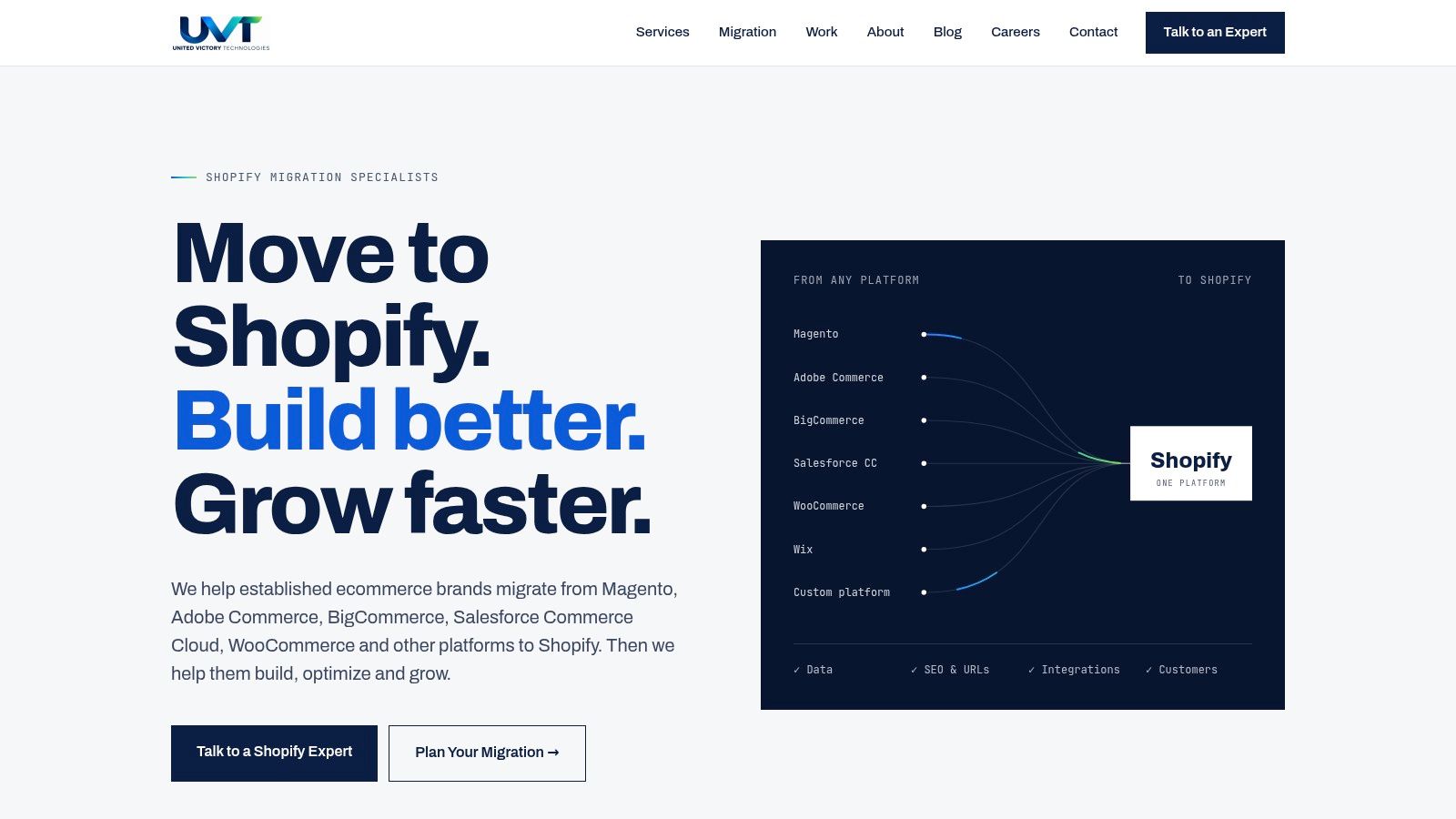
Our migration work is designed for established brands whose move involves more than a catalog transfer. We cover products and variants, customer accounts, order history, content, SEO URLs and redirects, integrations, and markets, alongside the Shopify storefront.
We rebuild for Shopify's section-based themes rather than assuming legacy templates should be reproduced. Our wider capabilities include Shopify Plus B2B, checkout extensibility, custom functionality, ERP/CRM/PIM/OMS integrations, international commerce, and ongoing optimization.
Evidence assessment: broad stated scope, anonymized project evidence, and assessment-led commercial terms. We describe ourselves as a Shopify Select Partner and work under NDA. That protects client confidentiality, but it also limits a buyer's ability to identify reference customers through public logos or named case studies.
<a id="what-the-evidence-does-and-doesnt-establish"></a>
What the evidence does and doesn't establish
Our anonymized Magento-to-Shopify Plus case reports 98% organic retention and a 34% conversion-rate increase. Those are project-specific results from a different source platform, not a forecast for a BigCommerce migration.
The stronger procurement question is whether the proposed delivery method addresses your actual dependencies. Our approach prioritizes data integrity, SEO continuity, integrations, customer experience, and revenue, with ongoing development and CRO available after launch.
- Strength: Migration and post-launch development can sit within the same engagement, reducing the need to hand unfinished operational work to another team.
- Trade-off: Pricing isn't published, so an assessment is needed before comparing costs or delivery assumptions.
- Evidence gap: Anonymized outcomes don't establish how your particular price lists, account rules, or historical transactions will behave.
Our Shopify Migration Readiness Assessment provides a scoped view of data, integrations, SEO risk, and a realistic timeline. For procurement, that scope should become named deliverables, acceptance tests, exclusions, and launch responsibilities.
Best fit: Brands seeking a coordinated Shopify or Shopify Plus rebuild with complex integrations and continuing development. The buying decision should turn on the assessed scope, not on applying another project's results to your business.
<a id="2-netalico"></a>
2. Netalico
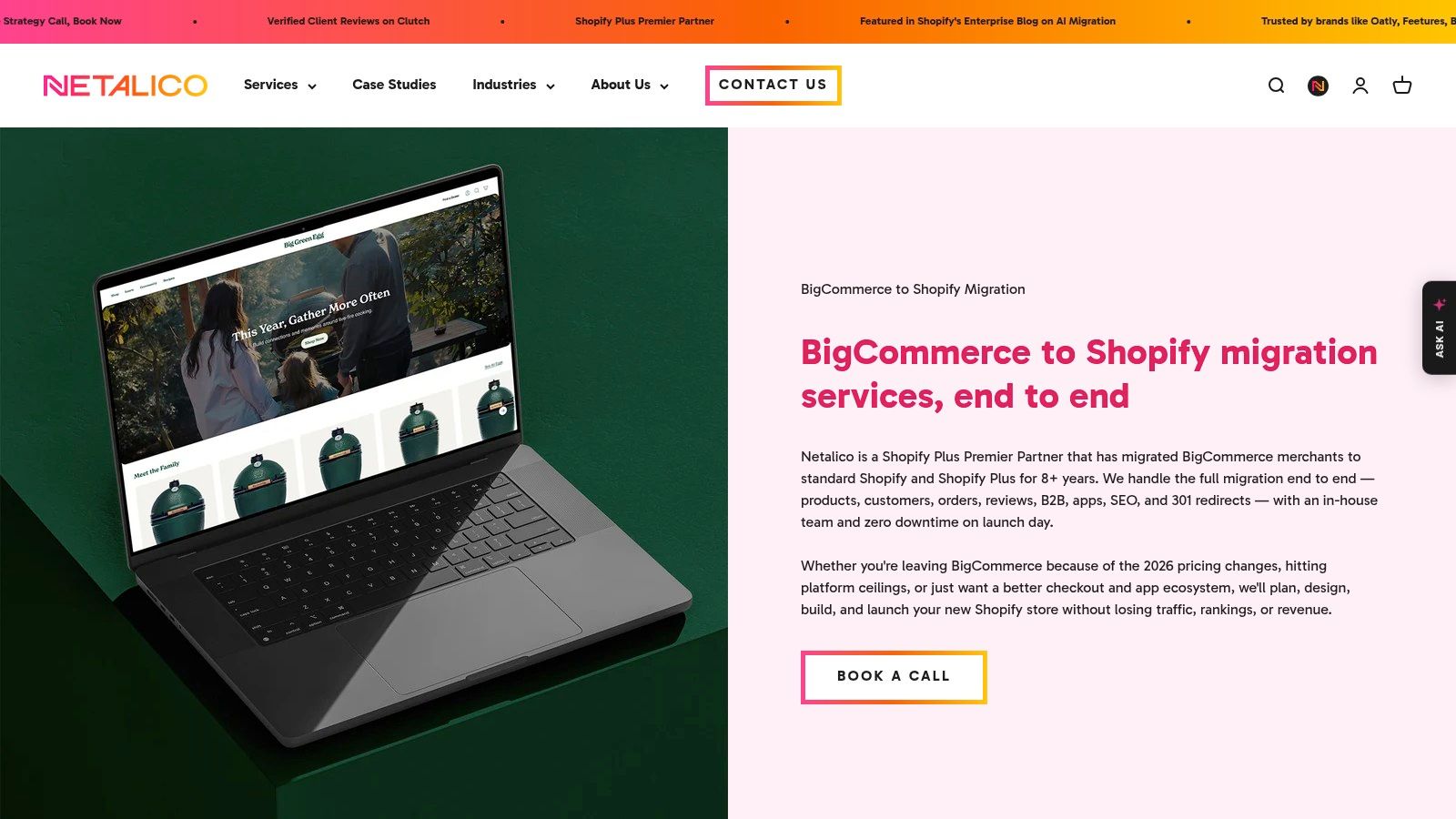
Netalico's clearest procurement advantage is commercial visibility. Its BigCommerce-to-Shopify migration page describes an end-to-end service and publishes indicative pricing and timeline guidance. Treat that guidance as a conversation starter, not a quote for your catalog and integrations.
The agency describes migration coverage spanning products, customers, orders, reviews, content, redirects, and B2B data. It also positions its services around Shopify and Shopify Plus, including more involved integration and international requirements.
Evidence assessment: useful commercial signals and relevant service specialization, with project assumptions still to verify. Public ranges help a buyer judge whether a discovery conversation is worthwhile. They don't establish whether a particular ERP connector, historical order transformation, or storefront redesign is included.
<a id="questions-that-turn-a-range-into-a-proposal"></a>
Questions that turn a range into a proposal
- Scope boundaries: Does the estimate include reviews, editorial content, account groups, and historical order exceptions, or only their standard import paths?
- Integration responsibility: Who specifies, builds, and tests ERP/OMS behavior, including failed messages and replay?
- Schedule assumptions: Which client approvals, data-cleaning tasks, and third-party dependencies must happen before the launch date can be committed?
- Support terms: Which post-launch defects are covered, and how are new feature requests distinguished from migration fixes?
Its published testimonials and project material are useful screening evidence, but request a comparable migration reference rather than relying on general satisfaction alone.
The publisher's guide to choosing a Shopify migration agency offers a framework for structuring that comparison. Netalico belongs on the shortlist when early budget visibility matters, provided the final proposal explains the assumptions behind its estimate.
<a id="3-1digital-agency"></a>
3. 1Digital Agency
A migration combined with a redesign and SEO engagement creates a different procurement problem from a migration-only project. You need to separate essential platform continuity from discretionary improvements, otherwise a single proposal can conceal competing priorities.
1Digital Agency's migration service describes data mapping, SEO preservation, integrations, and post-migration monitoring. Its wider offering includes design, development, SEO, PPC, and ongoing support, and it publishes a BigCommerce-to-Shopify Plus case study.
Evidence assessment: directly relevant service and case material, but limited public commercial specificity. Its broad capabilities may suit a merchant seeking coordinated delivery. They don't, by themselves, establish which specialists will work on the migration or what their acceptance criteria will be.
A combined migration and marketing proposal should still let you identify the cost, owner, and acceptance test for each migration-critical deliverable.
<a id="separate-launch-protection-from-growth-work"></a>
Separate launch protection from growth work
Ask the agency to distinguish required migration work from optional design and marketing changes. Redirect validation and integration testing shouldn't compete with campaign setup for the same undefined launch allowance.
The most useful questions concern ownership: Who approves the data mapping? Who tests destination pages after redirects? Who resolves an integration failure discovered after the store is live? Request the technical scope behind its published case study, not just the finished storefront.
The publisher's Shopify development agency guide can help frame the distinction between development capacity and migration accountability.
Best fit: Merchants who want migration connected to design and ongoing acquisition work. Main trade-off: Buyers seeking a narrowly defined transfer should confirm that a migration-only engagement is available and commercially sensible.
<a id="4-ehouse"></a>
4. ehouse
A relevant source-platform case is more useful than a generic migration promise. ehouse's public profile includes BigCommerce-to-Shopify experience associated with 4ocean, alongside strategy, design, development, integrations, and ongoing support.
The ehouse website positions the agency around broader commerce delivery. Its described scope makes it a candidate when replatforming also requires operational or omnichannel changes, rather than replacing the storefront.
Evidence assessment: relevant named-project evidence, with technical scope and commercial terms requiring clarification. The 4ocean example is a reason to investigate further, not proof that every migration dependency was handled by the same team. A buyer should distinguish the agency's specific responsibilities from the overall project story.
<a id="establish-who-owns-the-spaces-between-systems"></a>
Establish who owns the spaces between systems
Say a retailer is rebuilding its storefront while changing inventory routing. The storefront can pass visual review even though a fulfillment location receives the wrong order allocation. Procurement needs an owner for that cross-system behavior.
- Migration QA: Ask who reconciles source and destination records and who signs off on exceptions.
- SEO validation: Confirm whether the engagement includes URL inventory, redirect testing, canonical review, and post-launch crawl checks.
- Operational testing: Require scenarios covering inventory updates, cancellations, refunds, and fulfillment messages.
- Commercial scope: Request separate assumptions for migration, design, integration work, and ongoing support.
Best fit: A merchant evaluating migration as part of a wider commerce transformation. Main trade-off: Broader coordination can be useful, but it also makes responsibility harder to infer from a case study alone. The proposal needs to name the team accountable for each launch-critical workflow.
<a id="5-swanky"></a>
5. Swanky
Subscriptions change the meaning of migration success. Moving customer and order records isn't enough if the destination setup doesn't support the intended renewal, account-management, and customer-service workflows.
Swanky's BigCommerce-to-Shopify service describes storefront development, customer and order data, payment considerations, testing, and team training. Its FutureYou Cambridge case involves a hybrid BigCommerce/Magento environment and a subscription migration to Recharge.
Evidence assessment: relevant complexity evidence, especially for subscriptions, but not a like-for-like template for every BigCommerce store. The hybrid source environment matters. A buyer should establish which systems held the authoritative customer, subscription, payment, and order records before using the case as a comparison.
<a id="test-continuity-rather-than-record-counts"></a>
Test continuity rather than record counts
The strongest follow-up questions concern behavior after transfer:
- Subscription mapping: Which subscription attributes, product relationships, and customer identifiers will be retained or transformed?
- Payment dependencies: What requires coordination with the payment provider or subscription platform, and who manages those dependencies?
- Exception handling: How will the team identify records that can't follow the standard migration path?
- Delivery coverage: Which team will support your launch window, and what post-launch assistance is included?
For a subscription merchant, a successful import and a successful renewal are different acceptance tests.
Best fit: Shopify Plus projects where subscription continuity and legacy-system complexity deserve dedicated attention. Main trade-offs: Migration pricing isn't published, and buyers should confirm regional coverage, availability, and support arrangements.
Swanky's described testing and training are useful signals. The contract should translate those terms into business scenarios, staff responsibilities, and documented acceptance rather than leaving them as general process language.
<a id="6-coalition-technologies"></a>
6. Coalition Technologies
Coalition Technologies has a public BigCommerce-to-Shopify example involving Magnolia Boutique. The case describes product listings and images alongside work on customer experience, mobile experience, and backend functionality.
Coalition Technologies also offers ecommerce development and SEO migration services. That combination makes it relevant for retailers that want platform delivery coordinated with organic-search work.
Evidence assessment: a relevant retail case and adjacent SEO capabilities, but incomplete public technical detail. A catalog migration case establishes relevance; it doesn't establish how difficult your product options, custom fields, or inventory relationships will be.
<a id="ask-about-catalog-shape-not-just-catalog-size"></a>
Ask about catalog shape, not just catalog size
BigCommerce's catalog migration guidance warns that variant, image, catalog, and endpoint constraints can affect migration completeness. That makes the structure of the catalog a procurement issue, not merely a developer's implementation detail.
Ask Coalition to explain how its proposed team will map options, preserve image associations, and reconcile failed or inconsistent records. Request a sample transformation and an exception report before accepting a broad assurance that products will transfer.
For SEO, distinguish a redirect file from a complete validation engagement. The proposal should identify who checks destination relevance, internal links, metadata, indexing controls, and organic landing-page performance after launch.
- Strength: Development and search work can be evaluated together.
- Trade-off: No public migration price range establishes project fit.
- Reference request: Seek a recent project with similar catalog structures and integration dependencies, not another fashion retailer.
Best fit: Retailers seeking coordinated catalog, storefront, and SEO work. The decisive evidence will be the proposed team's mapping and validation method.
<a id="7-total-commerce"></a>
7. Total Commerce
For a hybrid B2B/DTC merchant, the difficult question is whether the destination preserves commercial rules. A company account can exist in Shopify while its purchasing permissions, negotiated prices, or approval process still behave incorrectly.
Total Commerce lists BigCommerce among its migration source platforms and describes capabilities across Shopify Plus, B2B, ERP/PIM integrations, international commerce, and ongoing growth work. Its public directory presence provides a starting-price signal, but that isn't a project-specific BigCommerce quote.
Evidence assessment: relevant capability breadth and commercial signaling, with less BigCommerce-specific case detail to evaluate. General directory reviews can support initial screening. They don't verify experience with your combination of account structures, pricing rules, and connected systems.
<a id="make-b2b-behavior-the-demonstration"></a>
Make B2B behavior the demonstration
Ask for a walkthrough built around your operating model rather than a generic Shopify demonstration.
- Pricing ownership: Which system controls negotiated prices, and how are updates reconciled?
- Company relationships: How will buyers, company locations, permissions, and account-specific rules map?
- Integration failures: What happens when an ERP rejects an order or a PIM update arrives late?
- International rules: Which market-specific catalog, currency, content, and availability requirements are included?
The publisher's BigCommerce-to-Shopify migration guide offers context for defining those dependencies before vendor discussions.
Best fit: Merchants whose selection criteria center on B2B, enterprise integrations, and international operations. Main trade-off: A broad capability statement needs comparable project evidence before it can support a complex migration decision. Request a reference involving the workflows that matter to your business, with clear confirmation of what the agency delivered.
<a id="published-pricing-timelines-and-best-fit-scenarios-across-seven-bigcommerce-migration-providers"></a>
Published Pricing, Timelines, and Best-Fit Scenarios Across Seven BigCommerce Migration Providers
| Item | Public Price Signal | Published Timeline | Best For |
|---|---|---|---|
| United Victory Technologies | No public pricing; request an assessment | Not published | Established brands needing complex migrations, integrations, and post-launch CRO |
| Netalico | $15,000–$30,000 simple; $30,000–$60,000 mid-market; $75,000–$150,000+ enterprise | 8–12 weeks simple; 16–24 weeks complex | Mid-market and enterprise BigCommerce merchants, including Shopify Plus projects |
| 1Digital Agency | No standard price range published | Not published | Brands combining migration with design, development, SEO, or marketing |
| ehouse | Contact for pricing | Not published | Merchants pairing migration with integrations or omnichannel changes |
| Swanky | No public pricing | Not published | Shopify Plus migrations involving subscriptions or complex legacy platforms |
| Coalition Technologies | No public migration price range | Not published | Merchants with large catalogs seeking migration and SEO support |
| Total Commerce | Migration starting at $20,000 | Not published | Shopify Plus projects involving B2B, ERP/PIM integrations, or international commerce |
<a id="turning-this-shortlist-into-a-migration-plan-you-can-defend"></a>
Turning This Shortlist Into a Migration Plan You Can Defend
Narrow the field to providers that match your catalog structure, integration dependencies, commercial requirements, and budget expectations. Don't send each agency a different version of the brief. Give them the same inventory of systems, data types, markets, custom functionality, and known exceptions so their proposals can be compared.
Request a scoped proposal naming who owns data validation, redirect mapping, integration testing, and post-launch fixes. Require a comparable reference project before signing, with enough technical context to understand the provider's actual responsibilities. Where confidentiality prevents a named reference, evaluate the available evidence accordingly rather than treating anonymized outcomes as independently verified proof.
<a id="require-evidence-at-each-acceptance-point"></a>
Require evidence at each acceptance point
- Data acceptance: Reconcile totals and test relationships, including variants, customer-order links, pricing, and image associations.
- Business acceptance: Have merchandising, customer service, finance, and operations test the workflows they'll use after launch.
- Search acceptance: Approve the URL map, destination relevance, metadata, internal links, and indexing controls.
- Launch acceptance: Document the final synchronization, cutover authority, escalation contacts, and conditions for delaying launch.
- Support acceptance: Define defect coverage, response arrangements, exclusions, and ownership of unresolved issues.
Execution details matter even when the storefront looks finished. BigCommerce's API rate-limit documentation explains that connected applications share quotas, so a migration pipeline must account for production integrations rather than assuming unrestricted extraction. Ask for resumable processing, logged exceptions, and a final reconciliation of changes made during the build.
Contract test: If a critical workflow fails after launch, the proposal should already tell you who investigates, who fixes it, and whether the work is covered.
Our migration scope covers data, SEO URLs and redirects, integrations, markets, and storefront delivery, with ongoing development available after launch. Those capabilities still need to be translated into your project's acceptance criteria.
The defensible choice isn't necessarily the cheapest proposal or the agency with the broadest service list. It's the provider whose evidence, exclusions, responsibilities, and validation plan let your team explain what you're buying and how you'll know it works.
For a BigCommerce-to-Shopify move, we offer structured migration covering data, SEO redirects, storefront development, integrations, and international-market requirements. Visit United Victory Technologies to request a Migration Readiness Assessment and turn your current stack into a scoped discussion of risks, dependencies, and delivery requirements.