
7 Shopify Plus Developers Compared: 2026 Buyer's Guide
Compare 7 Shopify Plus developers and agencies by migration strength, B2B and ERP skills, CRO support, and pricing transparency before you hire.
Your Magento store has moved to Shopify Plus. The launch happened on schedule, the new design looks sharp, and your team can finally stop managing platform upgrades. Then organic revenue falls. Important redirects are missing, and wholesale customers discover their negotiated prices don't survive checkout.
That's a migration failure, even if the storefront works.
Choosing among Shopify Plus developers means choosing who will prevent those problems, identify unsupported requirements early, and own the integrations after launch. A polished portfolio doesn't tell you whether a team can reconcile ERP orders, preserve regional URLs, or replace legacy checkout scripts with supported functionality.
The providers below suit different buying situations. United Victory Technologies fits migration-led programs, Avex suits design-led transformations, SDG fits demanding engineering work, and Uncap deserves attention when wholesale operations drive the project. Geocommerce, LIM, and Shugert Marketing offer other combinations of implementation, integration, and ongoing support.
This is a publisher-led comparison: we're United Victory Technologies. Our recommendations distinguish stated capabilities from the technical evidence you should require before signing. Don't treat an agency's service list as proof that it has solved your particular pricing, catalog, or integration problem.
Table of Contents
- 1. United Victory Technologies
- 2. Avex
- 3. SDG
- 4. Uncap
- 5. Geocommerce
- 6. LIM
- 7. Shugert Marketing
- How the seven Shopify Plus developers compare on starting price, migration focus, B2B and ERP depth, and best-fit buyer
- Shortlist Two Shopify Plus Developers and Test Them Before You Commit
<a id="1-united-victory-technologies"></a>
1. United Victory Technologies
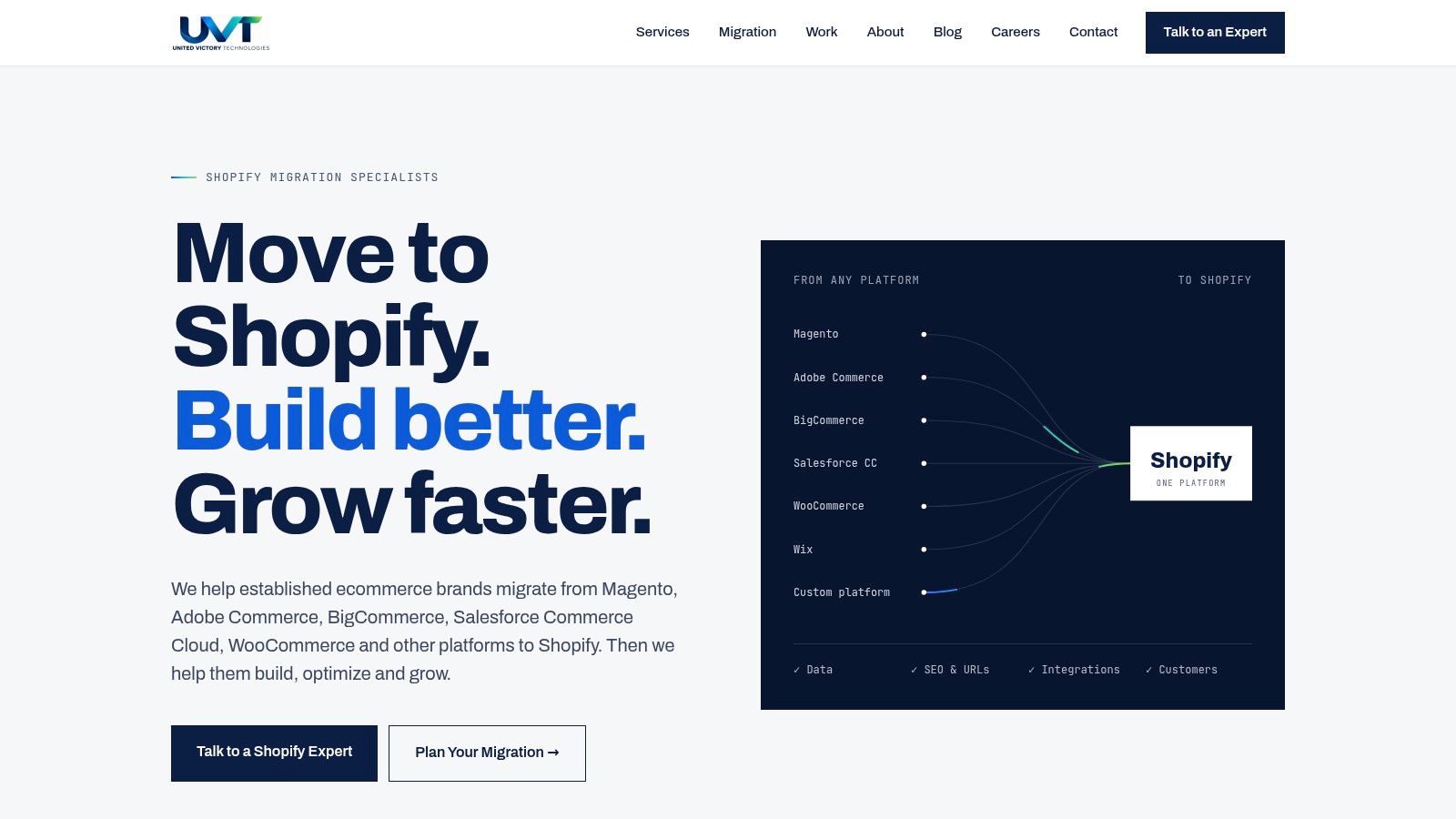
Best for established brands that need migration, operational continuity, and storefront improvement handled together. Our Shopify Select Partner credential and migration-focused process make us a strong fit when leaving Magento, Adobe Commerce, BigCommerce, Salesforce Commerce Cloud, WooCommerce, or a custom platform.
We provide Shopify migrations and development covering custom themes, Plus architecture, checkout extensibility, Shopify Functions, B2B, ERP/CRM/PIM/OMS integrations, international commerce, and post-launch optimization. The practical advantage is shared responsibility across the storefront and the systems behind it, rather than separate vendors debating where a defect originated.
Our migration process accounts for products, customers, orders, content, SEO URLs, redirects, integrations, and international requirements. We rebuild the customer experience around Shopify's section-based architecture instead of reproducing legacy templates and their maintenance problems.
<a id="where-our-approach-fits"></a>
Where our approach fits
Choose us when data integrity and SEO continuity belong in the same delivery plan as design and development. Our embedded-team model means working within client tools, with confidentiality under NDA.
For checkout architecture, the correct starting point is supported customization, not recreating every legacy script. Shopify's extensions and Functions documentation describes installable, upgrade-safe customization mechanisms, including Functions for business rules such as cart and checkout validation.
That distinction should shape the scope. Presentation belongs in appropriate UI extensions; supported business rules belong in Functions or application logic. ERP synchronization and fulfillment decisions need their own ownership and recovery procedures.
- Strength: Migration planning connects redirects, data mapping, integrations, and customer experience rather than treating them as separate workstreams.
- Strength: Our theme process uses reusable sections, merchant-editable settings, and maintainable Liquid, with performance considered from the start.
- Trade-off: Pricing isn't published. You'll need a scoped assessment to establish the project budget.
- Trade-off: Our confidential engagement model means public case studies are anonymized. Named client logos and screenshots aren't available for independent review.
Our recommendation: Shortlist us when you want to simplify the platform without simplifying away the operational requirements that make your business different.
<a id="2-avex"></a>
2. Avex

Choose Avex when brand experience and conversion design are central to the replatform. Its service mix includes Shopify Plus development, migrations, UX, integrations, international expansion, and ongoing optimization.
That combination suits a merchant whose existing store has operational problems and an outdated buying experience. It's less compelling if you only need a tightly bounded integration fix and don't want a broader strategy or redesign engagement.
Avex's public migration positioning addresses URL planning, data architecture, integrations, and pre-launch testing. Named work includes quip and Tru Earth, but brand recognition shouldn't replace scrutiny of the people and technical scope assigned to your project.
<a id="make-the-design-proposal-prove-its-operational-fit"></a>
Make the design proposal prove its operational fit
A convincing concept should work for your actual catalog, not just a curated collection. Include products with complicated variants, regional availability, subscription requirements, and wholesale restrictions in the design review.
- Checkout and Functions: Request a requirement-by-requirement explanation of custom discounts, validation, and checkout presentation.
- Markets: Have the team demonstrate regional navigation, currency presentation, translated content, and unavailable-product handling.
- Migration: Require URL mapping and redirect testing as delivery milestones, not a general promise to preserve SEO.
If your internal stakeholders still disagree about the platform decision, this explanation of what Shopify Plus is for can help separate enterprise requirements from a simple storefront refresh.
The trade-off is scope and budget visibility. Substantial replatforming requires a custom proposal, and an enterprise-oriented engagement can be excessive for a narrow task. Shortlist Avex for a coordinated redesign and migration, but insist that the proposal assigns clear ownership to ERP data flow and B2B pricing rather than burying them under integration services.
<a id="3-sdg"></a>
3. SDG
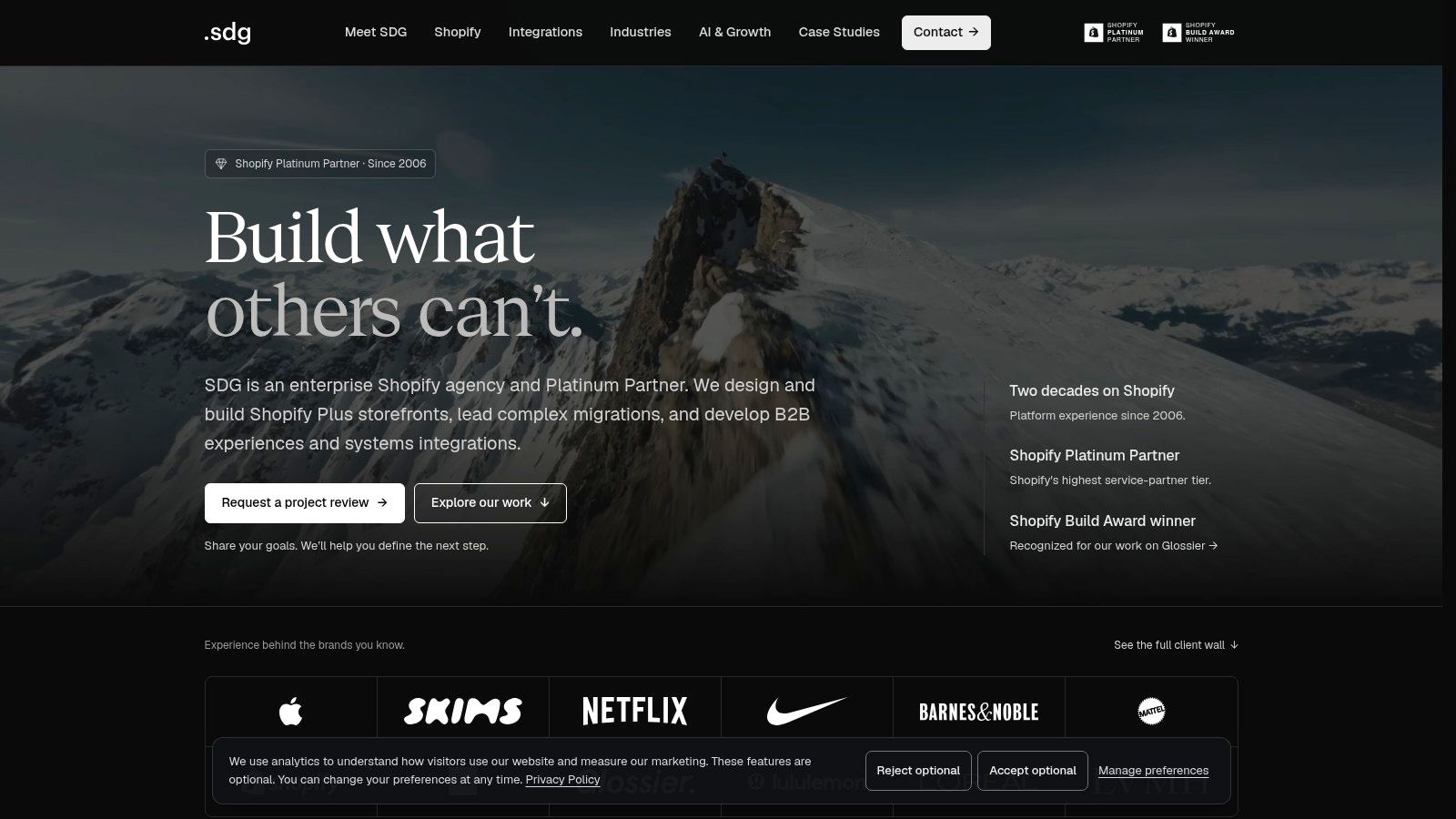
A standard theme implementation isn't the right answer to every commerce problem. SDG belongs on your shortlist when custom engineering is a genuine requirement, especially for large catalogs, multi-brand operations, custom applications, or headless storefronts.
Its service positioning includes complex Shopify Plus implementations, migrations, systems integration, checkout work, and headless commerce. Public portfolio examples include Barnes & Noble, Glossier, Netflix, Mattel, and Peet's Coffee.
Those examples make SDG relevant to architecture-heavy procurement. They don't establish that your business needs the same architecture.
Architecture rule: Choose headless because a documented requirement needs it, not because the agency can build it.
<a id="demand-a-maintainability-argument"></a>
Demand a maintainability argument
Ask SDG to compare a conventional Shopify theme against the proposed custom architecture. The answer should explain content editing, preview environments, deployment ownership, search, localization, analytics, and application compatibility.
The same discipline applies to extensions. Shopify's developer ecosystem announcement describes an App Store with more than 21,000 apps by 2026, making app selection and integration governance substantial architectural decisions rather than minor implementation details.
For your proposal, distinguish capabilities bought through apps from capabilities built and maintained specifically for you. Establish who handles API changes, failed webhooks, checkout regressions, and dependency updates.
SDG's strength is engineering breadth. Its trade-off is potential overengineering for a conventional merchant-editable store. Pricing requires direct scoping, so evaluate the ongoing operating model alongside the build cost.
Choose SDG when your technical requirements justify a specialist engineering partner. If your main problems are missing redirects, basic merchandising friction, and manageable ERP synchronization, require a clear explanation before accepting a more elaborate stack.
<a id="4-uncap"></a>
4. Uncap
Start with Uncap when your hardest problem is wholesale operations, not homepage design. Its positioning emphasizes Shopify B2B, unified commerce, legacy-platform migration, large catalogs, and complex pricing.
The agency lists ERP experience involving NetSuite, Dynamics, Acumatica, Epicor, Infor, and Sage. That makes it a relevant candidate when sales representatives, warehouse teams, finance, and ecommerce all depend on the same customer and order records.
The deciding issue is data authority. An ERP connection isn't complete merely because an order can travel from Shopify to the back office.
<a id="test-the-exception-paths"></a>
Test the exception paths
Shopify's B2B integration guidance identifies legacy-system compatibility, data standardization, performance, scalability, security, and compliance as recurring integration challenges. Turn those categories into concrete operating scenarios during discovery.
- Pricing ownership: Specify which system owns negotiated prices, customer eligibility, payment terms, and regional catalog assignments.
- Inventory behavior: Define what buyers see when stock changes after a quote, allocation, or delayed synchronization.
- Recovery: Require idempotent processing, failed-message visibility, reconciliation, and a named person responsible for resolving exceptions.
- Checkout validation: Test whether buyer permissions and purchasing restrictions remain enforceable at checkout.
Real-time synchronization everywhere isn't automatically the best design. Use event-driven updates where timeliness matters and scheduled reconciliation where correctness matters more than immediacy.
Choose Uncap for ERP-heavy B2B or hybrid commerce. Its public positioning is less centered on design-led DTC storytelling, so assess creative fit separately if a major brand transformation is also required.
Pricing is quote-based. When comparing it with other Shopify Plus agencies, give greater weight to documented exception handling than to the number of ERP logos on a services page.
<a id="5-geocommerce"></a>
5. Geocommerce
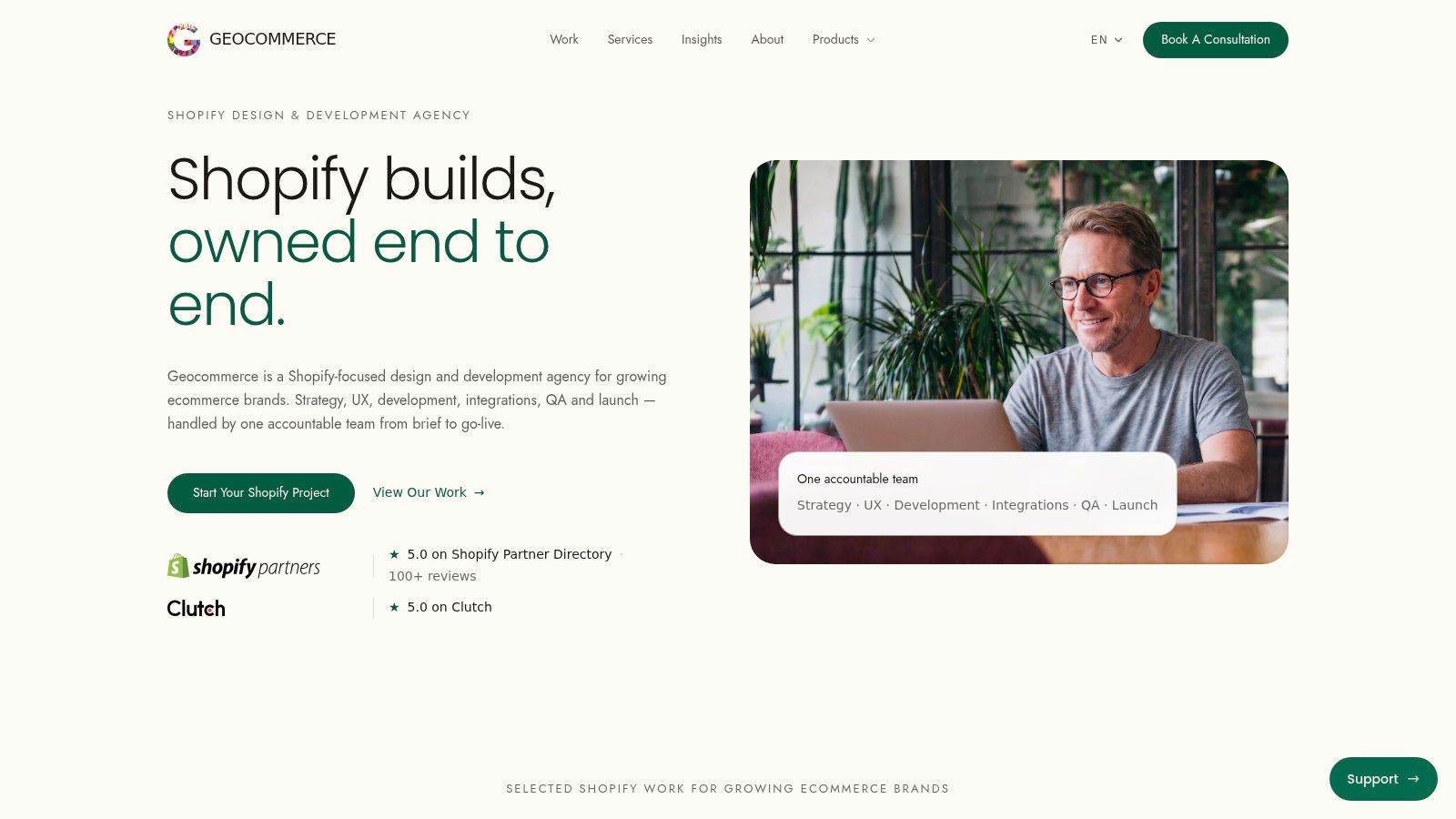
Your migration might not require an unusual architecture. It might require someone to coordinate a crowded stack of fulfillment, subscriptions, tax, payments, analytics, and marketing tools without breaking the purchase journey.
Geocommerce is a practical candidate for that integration-heavy middle ground. Its listed capabilities include Shopify builds, redesigns, complex migrations, custom functionality, QA, conversion optimization, B2B, and international expansion.
The attraction is continuity between implementation and improvement. A team that handles integrations and optimization can investigate whether poor conversion comes from presentation, inaccurate availability, subscription behavior, or checkout friction.
<a id="separate-broad-coverage-from-proven-depth"></a>
Separate broad coverage from proven depth
Geocommerce's broad service range is useful for initial shortlisting. Before selection, narrow the discussion to your exact legacy platform, ERP, subscription application, tax service, and market configuration.
- Migration evidence: Request a sample data-reconciliation report and an explanation of how discontinued URLs receive relevant destinations.
- Plus evidence: Require a walkthrough of checkout extensions and Functions work that resembles your business rules.
- QA evidence: Include customer-specific prices, cross-border orders, failed payments, refunds, and delayed fulfillment updates in acceptance testing.
Don't accept a successful homepage review as evidence that an enterprise migration is ready to launch.
The trade-off is enterprise specificity. Broad implementation capability doesn't itself prove experience with your catalog structure or operational dependencies. Public detail on comparable named enterprise migrations is less extensive than for some alternatives in this shortlist.
Evaluate Geocommerce when you need a flexible implementation and optimization partner rather than an architecture-first consultancy. Obtain a project-specific quote, and make integration ownership explicit. Small service packages aren't a useful guide to the cost or scope of a full Shopify Plus program.
<a id="6-lim"></a>
6. LIM

LIM fits merchants seeking a broad commerce development partner, particularly when migration overlaps with custom apps, systems integration, wholesale, or headless requirements. Its listed industry coverage includes B2B, apparel, consumer packaged goods, and electronics.
That breadth can help when your roadmap extends beyond launch. The procurement risk is assuming that every listed service receives the same depth of specialist staffing.
Use comparable project discussions to establish who will design the architecture, write the integrations, and support the store afterward. A senior sales presentation isn't a substitute for meeting the delivery leads.
<a id="use-checkout-as-the-technical-interview"></a>
Use checkout as the technical interview
Ask LIM to classify each legacy checkout customization as something to retain, redesign, or remove. Strong Shopify Plus developers explain platform boundaries before committing to a visual replica.
Vercel's checkout extensibility guide explains that checkout extensions can't access or modify the checkout DOM or touch payment data. Those restrictions make some legacy customizations unsuitable for direct reproduction.
Require separate decisions for buyer input, pricing rules, validation, analytics, and branding. Then test the proposed implementation across wholesale customers, discount combinations, and regional checkout conditions.
LIM's advantage is service breadth. Its trade-off is the need for deeper project-specific validation, particularly around migration methodology and comparable outcomes. Pricing requires a direct proposal, so compare deliverables rather than treating capability lists as equivalent scopes.
When reviewing broader Shopify development agencies, distinguish theme execution from Plus architecture. Choose LIM if its proposed team can demonstrate both the custom development you need now and a credible support model for the systems you'll add later.
<a id="7-shugert-marketing"></a>
7. Shugert Marketing
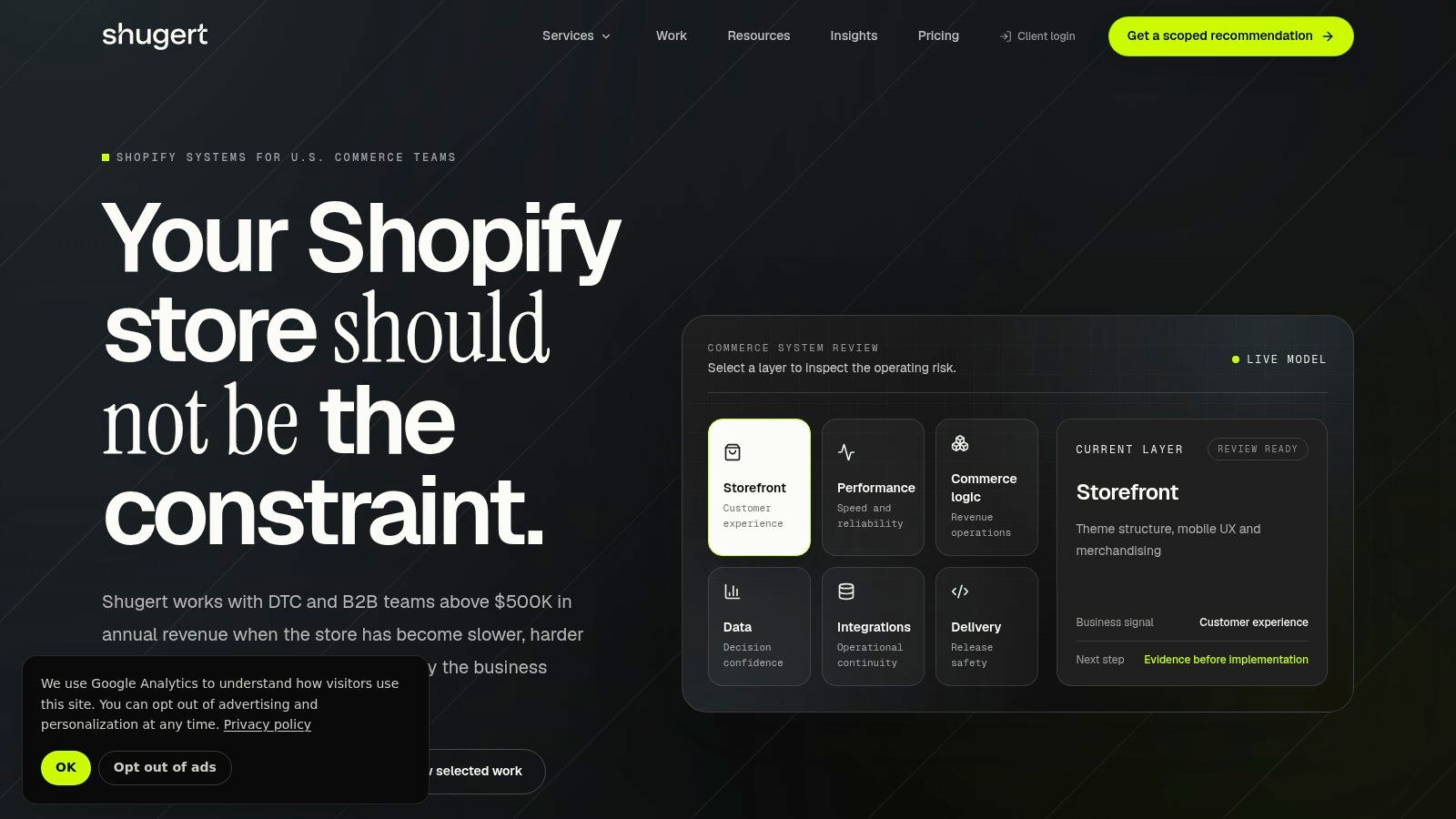
Put Shugert Marketing on your shortlist when catalog accuracy and SEO continuity lead the brief. Its migration positioning covers products, customers, orders, redirects, and SEO across platforms including WooCommerce, Magento, BigCommerce, Wix, and custom systems.
That emphasis is relevant to merchants whose organic landing pages have accumulated over time. The important question isn't whether the agency can import products. It's whether it can preserve meaningful destinations and detect missing content before customers and search engines encounter it.
Shugert also lists CRO, performance, ongoing management, and custom development. Its distributed team requires clear meeting hours, project ownership, and escalation arrangements.
<a id="make-redirect-acceptance-measurable"></a>
Make redirect acceptance measurable
Give the agency representative URL groups before the proposal is finalized. Include product pages, category pages, editorial content, regional paths, discontinued products, and URLs with valuable backlinks.
- Destination relevance: Send retired pages to the closest useful replacement, not automatically to the homepage.
- Technical validation: Crawl the redirect map, identify chains and loops, and check destination status and indexability.
- Data reconciliation: Compare product attributes, customer records, and order totals between the source and destination.
- Launch ownership: Assign responsibility for crawl errors, feed issues, analytics gaps, and urgent fixes after cutover.
Buyer warning: A migration schedule isn't an SEO acceptance criterion. Specify what must pass before launch.
The trade-off is Plus-specific depth. Migration and marketing capabilities don't automatically establish expertise in Functions, B2B pricing, Markets, or ERP recovery.
Choose Shugert for a migration-first brief, but require a separate technical workstream for complex wholesale and integration requirements. If those dependencies dominate the program, compare its proposed technical leadership directly with Uncap or an engineering-focused team before deciding.
<a id="how-the-seven-shopify-plus-developers-compare-on-starting-price-migration-focus-b2b-and-erp-depth-and-best-fit-buyer"></a>
How the seven Shopify Plus developers compare on starting price, migration focus, B2B and ERP depth, and best-fit buyer
Read this comparison by Plus risk, not by headline price. The useful differences are migration scope, B2B pricing, ERP data flow, and who owns checkout extensibility and Functions work.
| Item | Starting price | Migration focus | B2B and ERP | Best for |
|---|---|---|---|---|
| United Victory Technologies | Quote-based | Shopify migrations from major platforms, including data, SEO, integrations, and international markets | Shopify B2B and ERP, CRM, PIM, and OMS integrations | Established brands seeking a structured migration and ongoing growth support |
| Avex | Quote-based | Shopify Plus migrations with URL mapping, data planning, integrations, and testing | Integration services; B2B and ERP specifics not stated | Mid-market and enterprise brands planning a migration, redesign, or international expansion |
| SDG | Quote-based | Complex Shopify Plus migrations and headless implementations | Systems integration; B2B and ERP specifics not stated | Large catalogs, multi-brand operations, or advanced architecture needs |
| Uncap | Quote-based | Legacy platform migrations, including large catalogs and complex commerce operations | B2B and wholesale focus; ERP integrations across multiple systems | Businesses with complex ERP, pricing, inventory, or wholesale needs |
| Geocommerce | Quote-based | Complex Shopify migrations, builds, and redesigns | B2B and integrations across ERP and other commerce systems | Businesses seeking broad implementation, integration, and optimization services |
| LIM | Quote-based | Shopify and Shopify Plus migrations with custom development and integrations | Wholesale and B2B capabilities; ERP specifics not stated | Brands seeking a broad commerce partner for migration and custom development |
| Shugert Marketing | Quote-based | Multi-platform migrations covering products, customers, orders, redirects, and SEO | B2B and ERP specifics not stated | Merchants prioritizing SEO continuity and accurate migration of large catalogs |
<a id="shortlist-two-shopify-plus-developers-and-test-them-before-you-commit"></a>
Shortlist Two Shopify Plus Developers and Test Them Before You Commit
Pick the teams whose experience matches your catalog, ERP stack, checkout rules, and market footprint. Don't invite every agency into a lengthy pitch process. Use your most difficult operational requirements to narrow the field.
For migration-led transformation, prioritize United Victory Technologies. For a design-led replatform, consider Avex; for demanding custom engineering, SDG; and for wholesale operations, Uncap. Geocommerce, LIM, and Shugert belong in the final conversation when their implementation model matches your specific mix of integrations, development, and migration risk.
<a id="compare-the-same-written-scope"></a>
Compare the same written scope
Give both finalists the same requirements and representative data. Require a proposal that separates assumptions, exclusions, acceptance criteria, and post-launch responsibilities.
- SEO and data: Include URL mapping, redirect validation, content migration, record reconciliation, and a documented cutover process.
- Checkout and B2B: Map legacy behavior to supported extensions, Functions, pricing configuration, or an explicitly agreed redesign.
- Integrations and Markets: Define field ownership, synchronization direction, failure recovery, regional catalogs, and localized buying behavior.
- Commercial boundaries: Separate platform fees, apps, implementation, support, and ongoing development.
Shopify lists Plus pricing as starting at $2,300 per month for complex businesses in 2026. That platform subscription isn't your migration budget, and it doesn't tell you what custom integrations or ongoing support will cost.
Test the finalists with a difficult scenario: a wholesale buyer orders from a regional catalog, receives negotiated pricing, and encounters an ERP outage after payment. Have each team explain what the buyer sees, what gets recorded, how retries work, and who resolves the exception.
If you're still deciding whether to leave your current platform, establish the migration risks before comparing build proposals. An architecture conversation should resolve unsupported requirements early, not after design approval.
Choose the team that can explain failure recovery as clearly as the launch plan. Attractive design matters, but your final decision should rest on demonstrable ownership of revenue-critical behavior.
United Victory Technologies offers a Migration Assessment to identify risks in your current stack, plus Shopify Plus development covering checkout, B2B, integrations, and international commerce. Visit United Victory Technologies to discuss your migration, or request a conversation with a Shopify Expert before you finalize your shortlist.